
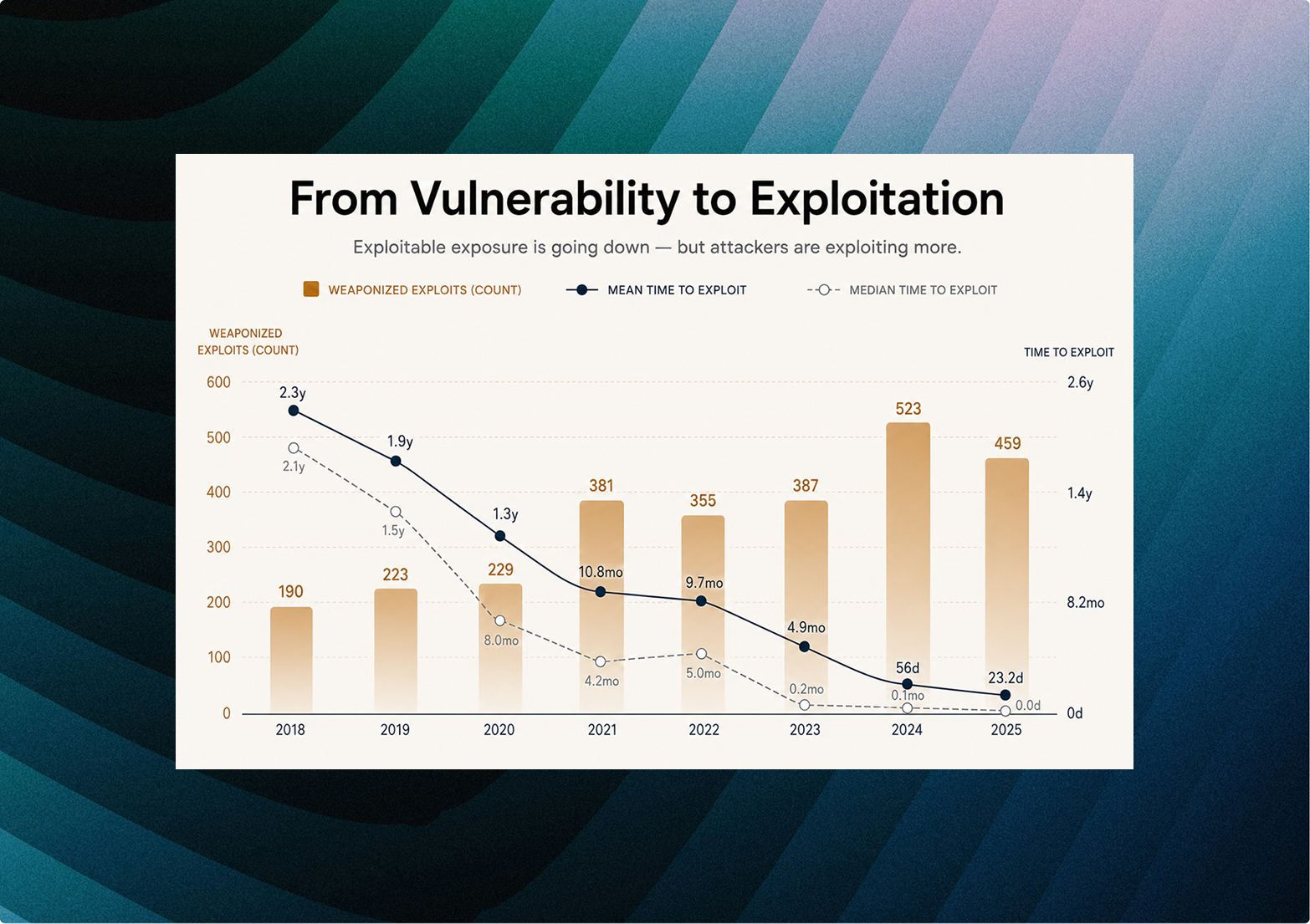
Attackers don’t wait for shift changes. They move through weak signals, exploit gaps between tools, and use AI to operate faster than any human-centered SOC can match. Most organizations respond by buying more tools. That’s the wrong answer. The problem isn’t tool coverage — it’s the operating model.
Most companies already own EDR, SIEM, identity protection, cloud security, and threat intelligence. Yet they can’t answer the questions that matter:
● Are our tools actually working together?
● Which detections are firing on real threats — and which are noise?
● What low-noise, non-obvious threats are we missing entirely?
● Are we improving security outcomes, or just generating more telemetry?
This is where modern Managed Detection & Response (MDR) changes the equation. But next-generation MDR is no longer outsourced alert monitoring. It’s an AI-native security operations control plane: an intelligent layer that continuously correlates, investigates, and responds across your entire stack in real time.
What “AI-Native” Actually Means
“AI-powered” is meaningless in security marketing.. Most are bolting generative AI onto the same legacy workflows.
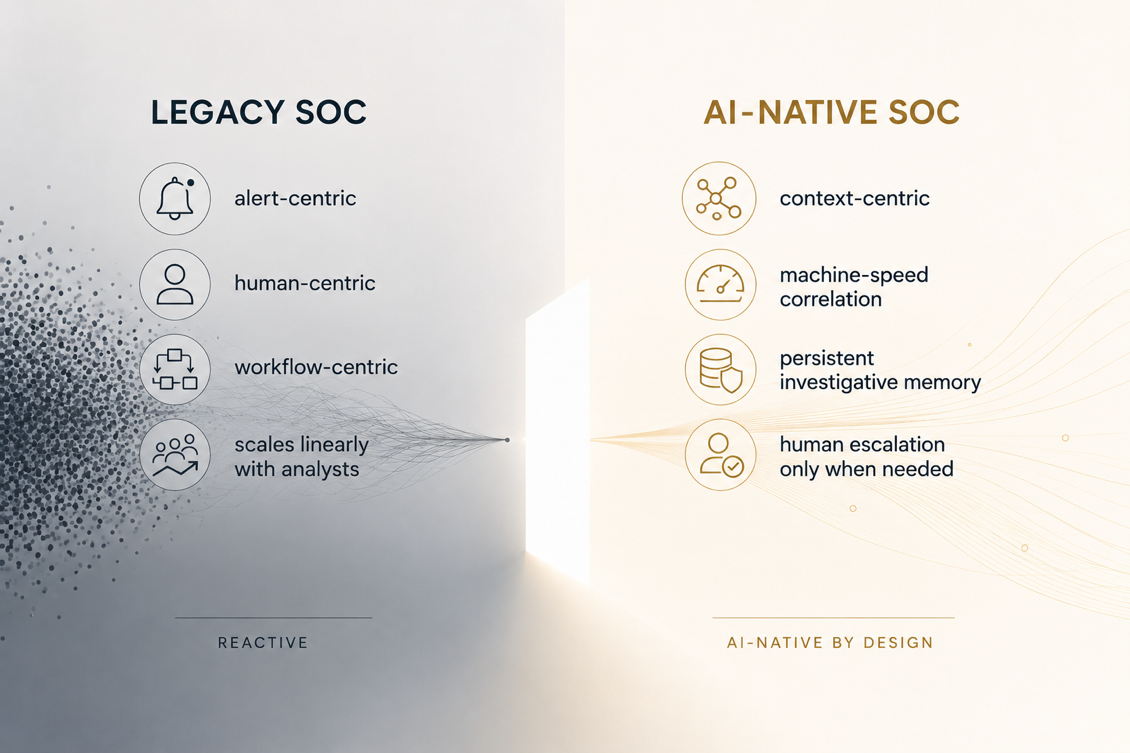
An AI-native MDR is different — AI is the operational fabric of the SOC itself, handling telemetry normalization, automated investigation, behavioral correlation, threat prioritization, and response orchestration. Not as an add-on. As the foundation.
Traditional MDR was built around manual triage, escalation queues, and human-heavy investigation. That model doesn’t scale against modern attack velocity. The next-generation AI SOC closes the loop: faster detection, reduced analyst fatigue, better prioritization, accelerated response, stronger outcomes..

But Here’s What Nobody Is Saying Loudly Enough
AI-native security operations creates a new concentration of power. When an AI system continuously ingests your telemetry, learns your environment, reasons about your threats, and executes response actions on your behalf — whoever controls that system controls your security posture.
Most organizations haven’t fully reckoned with what that means.
It means your investigation logic lives in someone else’s platform. Your threat context is stored in someone else’s infrastructure. Your AI models are trained on someone else’s terms. Your response actions are governed by someone else’s policies. And if that vendor raises prices, changes architecture, gets acquired, or goes down — your security operations go with them.
Sovereignty in security operations isn’t about nationalism or politics. It’s about who has the kill switch — and whether it’s you.
For European organizations, this has a regulatory dimension that is becoming impossible to ignore. NIS2 requires demonstrable operational resilience. GDPR governs how investigation data is handled. DORA mandates operational continuity for financial entities. These frameworks don’t just ask whether your AI works. They ask whether you can explain it, audit it, and control it.
A security operation running on AI you don’t control, in a jurisdiction you didn’t choose, governed by policies you can’t inspect, is not a sovereign security operation. It’s a dependency.
What Operational Sovereignty Actually Requires
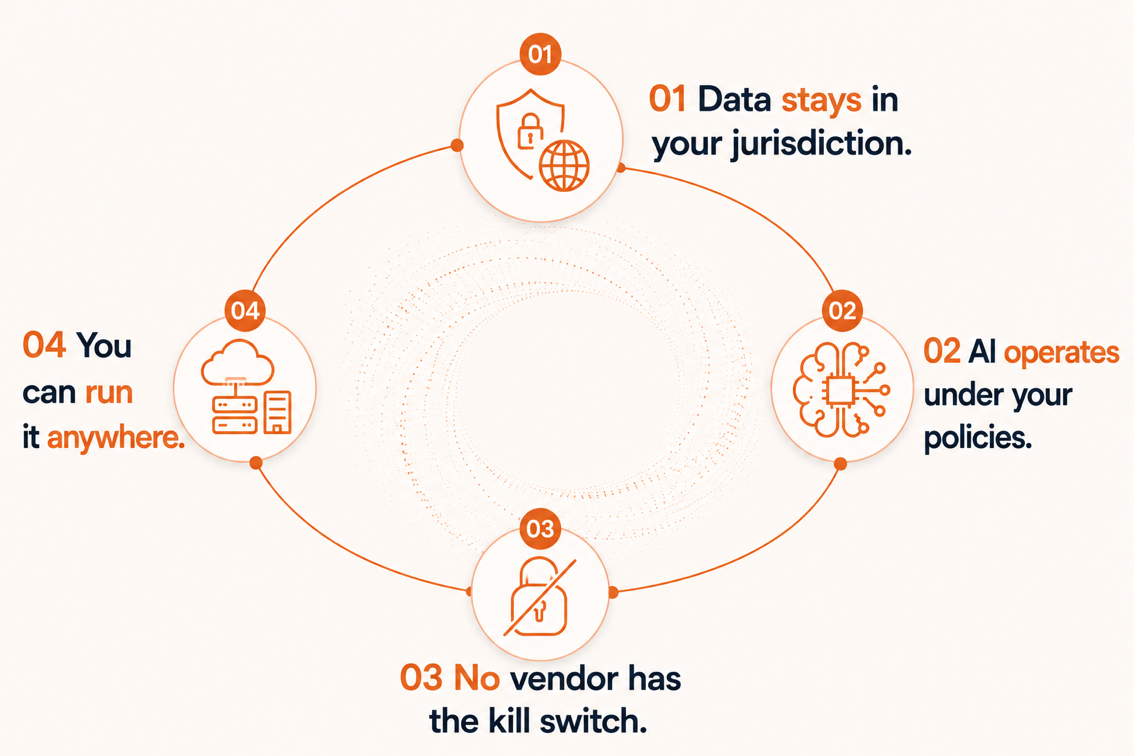
Sovereignty in security operations isn’t a feature. It’s an architectural commitment. It means four things:
- Data stays in your jurisdiction. Your telemetry, investigation data, enrichment context, and threat intelligence never leave your control. No cross-border transfers, no hidden cloud dependencies, no shared infrastructure that makes your data someone else’s asset.
- AI operates under your policies. You decide which models run on your data, where inference happens, and how AI-driven decisions are governed and audited. Local models, bring-your-own, or commercial with private access — model choice is yours, not the vendor’s.
- No vendor has the kill switch. No tool lock-in, no deployment lock-in, no AI lock-in. Your security operations don’t depend on any single vendor’s roadmap, pricing model, or continued existence.
- You can run it anywhere. Cloud, on-premises, hybrid, or inside your own walls. As AI makes it easier to operate security independently, a sovereign platform runs wherever your organization needs to go — including fully in-house if that’s where the market heads.
Sovereignty isn’t a compliance checkbox. It’s the difference between a security operation that belongs to you and one you’re renting access to.
Governance Is Not the Enemy of AI. It’s What Makes AI Trustworthy.
There’s a version of the AI-native SOC conversation that sounds like: let the machines run everything and get humans out of the loop. That’s not what we’re describing. And for most enterprises — especially those operating under NIS2, DORA, GDPR, and sector-specific resilience requirements — it’s not what they want.
The question isn’t whether AI can act autonomously. It’s whether you can put AI-driven decisions in front of a regulator and explain exactly how they were made.
Auditability is a prerequisite. High-risk response actions require validation. AI-generated investigations must be reviewable and traceable. Escalation paths must be policy-driven. Organizational controls must remain enforceable even as the system operates at machine speed.
Humans in a sovereign AI SOC aren’t gatekeepers slowing the system down. They’re callable participants the system can summon at any point — for judgment, confirmation, or context that only a human holds. That distinction matters. It’s the difference between humans as bottlenecks and humans as the governing intelligence the system knows when to trust.
The Next Decade Won’t Be Won With Better Copilots
The goal isn’t a SOC without humans. It’s a SOC where the humans in it are doing work that actually requires them — and where sovereignty over how the whole system operates never leaves your hands.
The security vendors who win over the next decade won’t be the ones with the slickest AI interface bolted onto a legacy SIEM. They’ll be the ones who took the harder path: rethinking the underlying infrastructure itself.
Data models designed for machine correlation, not human readability. Persistent investigative memory that survives shift changes. Enrichment pipelines that run continuously. Feedback loops that compound over time. And a governance architecture that makes every AI decision explainable, auditable, and reversible.
The organizations that figure out how to scale security capability without scaling headcount — while keeping genuine control over how that capability operates — will be ahead. The ones that keep layering copilots onto legacy workflows, or trade sovereignty for speed, will keep fighting yesterday’s battle with yesterday’s tools and someone else’s platform.
What We Believe
Sovera Security was founded on a set of convictions we intend to hold:
- Security operations should be AI-native, not AI-assisted. The architecture has to be built for agents from the ground up — not adapted from workflows designed for analysts.
- Sovereignty is non-negotiable. Data residency, AI model control, vendor independence, and deployment flexibility are not features. They are founding principles.
- Humans belong in the loop, not at the end of it. The right model is human judgment on demand — callable at any point where it matters, not just as a final sign-off.
- Governance makes AI deployable, not slow. Auditability, explainability, and policy enforcement are what let organizations adopt AI at speed without losing control of what it does.
- The moat is data, customers, and trust — not the AI itself. AI capabilities will commoditize. The organizations and providers that compound proprietary data, deep customer context, and earned trust will be the ones that matter in ten years.
These aren’t product decisions. They’re values decisions. And we believe they’re the right ones for the organizations — and the era — we’re building for.
About Sovera Security
Sovera Security is an AI-native, sovereign MDR platform built from the ground up for European enterprise environments. Headquartered in Copenhagen, Sovera combines agentic AI-driven detection and response with 24/7 analyst coverage, deep GDPR and NIS2 expertise, and European data residency by design. No retrofitted legacy tooling. No dependence on non-European infrastructure.
Want to see what sovereign security operations look like in practice?
Sign up for a free assessment. Our founding team will map your current stack, identify where sovereignty and operational control are at risk, and show you what closing those gaps looks like.