
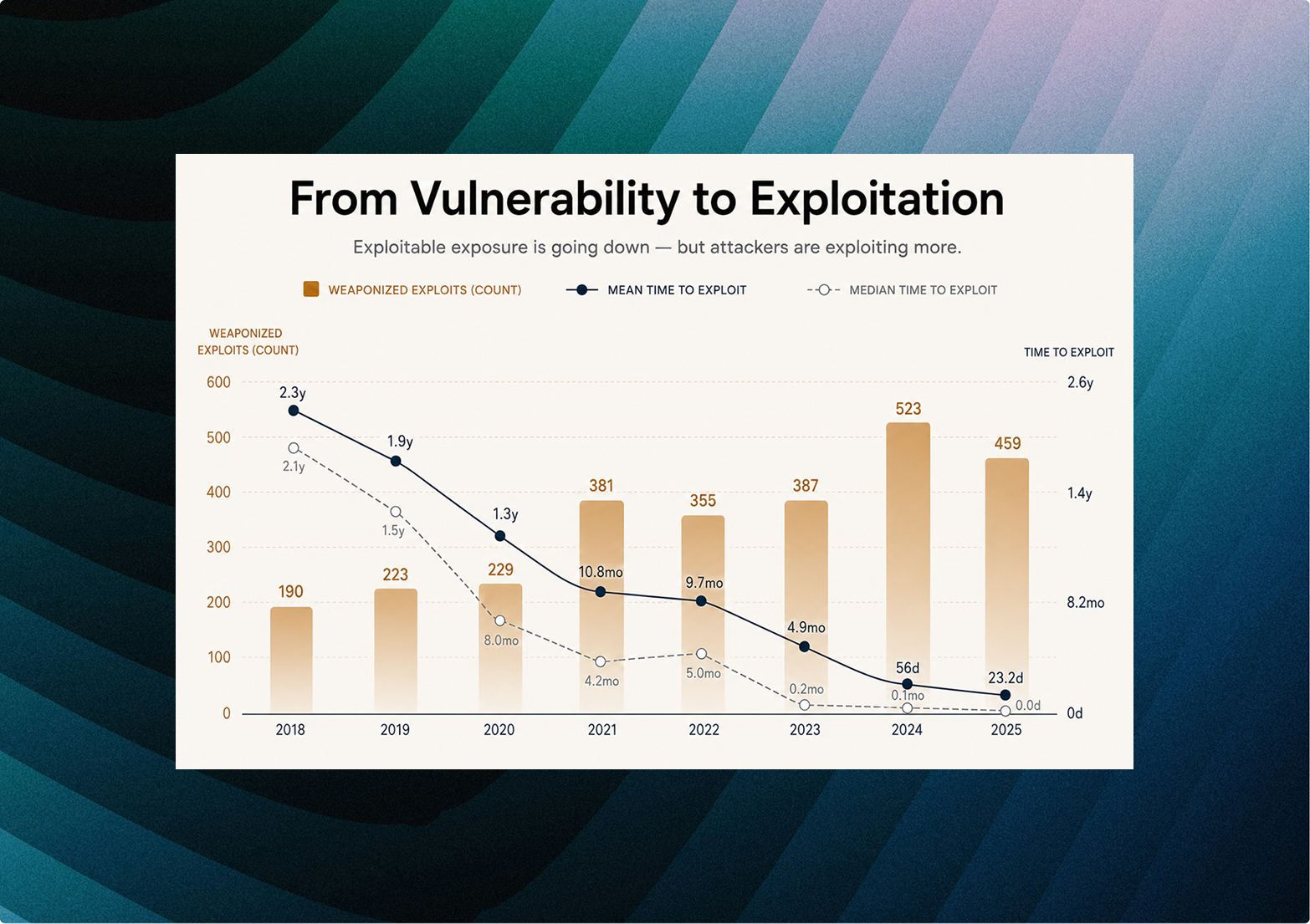
Attackers don’t wait for shift changes. They move through weak signals, exploit gaps between tools, and use AI to operate faster than any human-centered SOC can match. Most organizations respond by buying more tools. That’s the wrong answer. The problem isn’t tool coverage, it’s the operating model.
Most companies already own EDR, SIEM, identity protection, cloud security, and threat intelligence. Yet they can’t answer the questions that matter:
● Are our tools actually working together?
● Which detections are firing on real threats and which are noise?
● What low-noise, non-obvious threats are we missing entirely?
● Are we improving security outcomes, or just generating more telemetry?
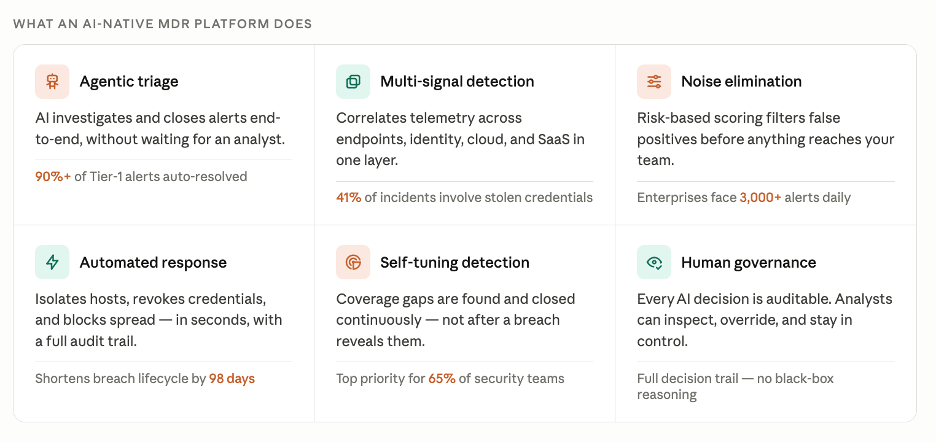
This is where modern Managed Detection & Response (MDR) changes the equation. But next-generation MDR is no longer outsourced alert monitoring. It’s an AI-native security operations control plane: an intelligent layer that continuously correlates, investigates, and responds across your entire stack in real time.
Why "AI Powered" Isn't the Bar
Every MDR vendor now claims AI. Most of it is generative AI duct-taped onto the same alert queues and escalation paths that have run SOCs for a decade.
The distinction that actually matters is whether AI is the thing doing the work or the thing describing the work. In an AI-native MDR, telemetry normalization, automated investigation, behavioral correlation, threat prioritization, and response orchestration run through the AI layer by default. It is not as a bolt-on feature but the foundation the rest of the platform sits on.
Traditional MDR was built around manual triage, escalation queues, and human-heavy investigation. That model doesn’t scale against modern attack velocity. The next-generation AI SOC closes the loop: faster detection, reduced analyst fatigue, better prioritization, accelerated response, stronger outcomes.
What European Enterprises Must Ask Their MDR Provider
For European organizations, cybersecurity isn’t just a technology problem: it’s a regulatory and sovereignty problem. NIS2 raises the bar on operational resilience and board-level accountability. GDPR shapes how investigation data is handled. Your MDR provider has to answer:
· Can you show us, contractually, where our telemetry physically resides?
· Who on your team (and in what location) can view our investigation data?
· What governance controls can you put in front of an auditor today, not hypothetically?
· What's your actual mean time to containment, backed by evidence?
· Can you show a track record of operational response, not just monitoring uptime?
The Real Cost of Waiting
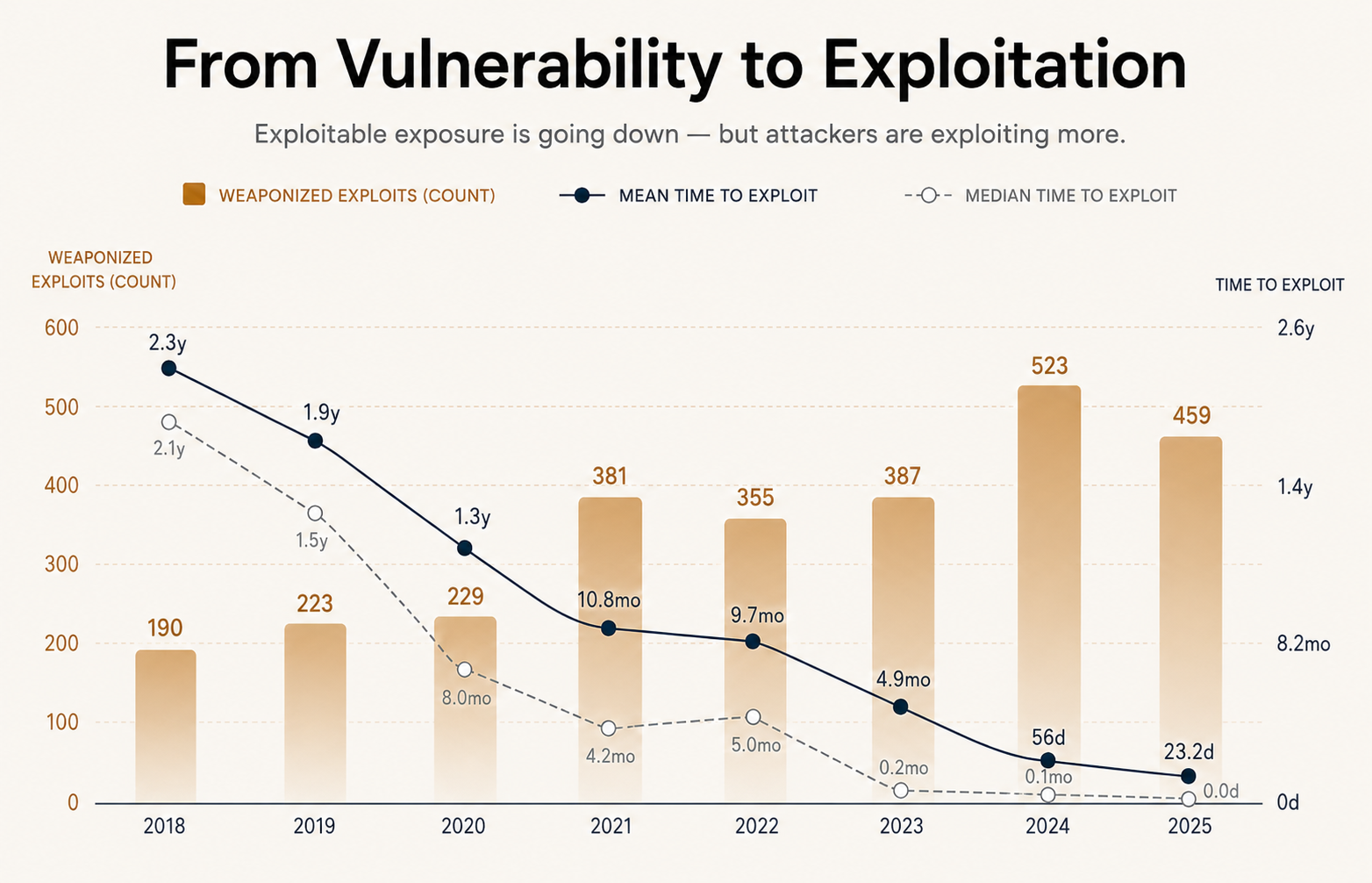
The IBM Cost of Data Breach Report 2025 puts the average breach at $4.88M with organizations lacking MDR-level monitoring consistently slower to detect and contain. In fact, with attackers now leveraging AI, the mean time to exploit has been dramatically accelerating while the total measurable exploits are still rising:
The right MDR becomes your 24/7 monitoring capability, investigation team, escalation layer, and force multiplier for the stack you already own. The goal isn’t to replace your tools. It’s to make them operational. In fact, Meriplex recently found that customers who implemented MDRs saw a 201% ROI over three years on the investment, with payback in under 6 months.
What to Look for in an AI-Native MDR Provider
The MDR market is crowded. Most providers claim AI. Few have rebuilt their operating model around it. Evaluate on:
● AI-native architecture — not AI bolted onto legacy alert workflows
● Human + AI governance — clear on what agents decide, what analysts own, what requires approval
● Detection engineering — continuous improvement, not a static rule library
● Sovereignty — data residency, AI model control, deployment flexibility, vendor independence
● Measurable outcomes — risk reduced, not alerts processed
● Transparency — full audit trail of investigations, reasoning, and actions
Avoid providers that operate as black boxes, forward alerts instead of investigating them, can’t explain their AI architecture, or can’t deploy within your jurisdiction.
What AI-Native Security Operations Actually Look Like
Without operational coordination, security tools run in silos, generate noise, and underdeliver. AI-native security operations change this:
● EDR alerts enriched automatically with identity, cloud, and operational context (i.e.employee role, device history, behavioral baseline)
● SIEM detections become prioritized investigations, not raw telemetry queues
● Email and identity threats correlated across users, devices, SaaS, and infrastructure
● Weak signals and low-noise indicators surfaced before they become incidents
● Duplicate alerts suppressed. Investigations faster. Response in minutes.
Fewer false positives, faster triage, reduced dwell time, accelerated response, and dramatically less manual effort. Every resolved case improves the next one. Security operations that compound over time.
About Sovera Security
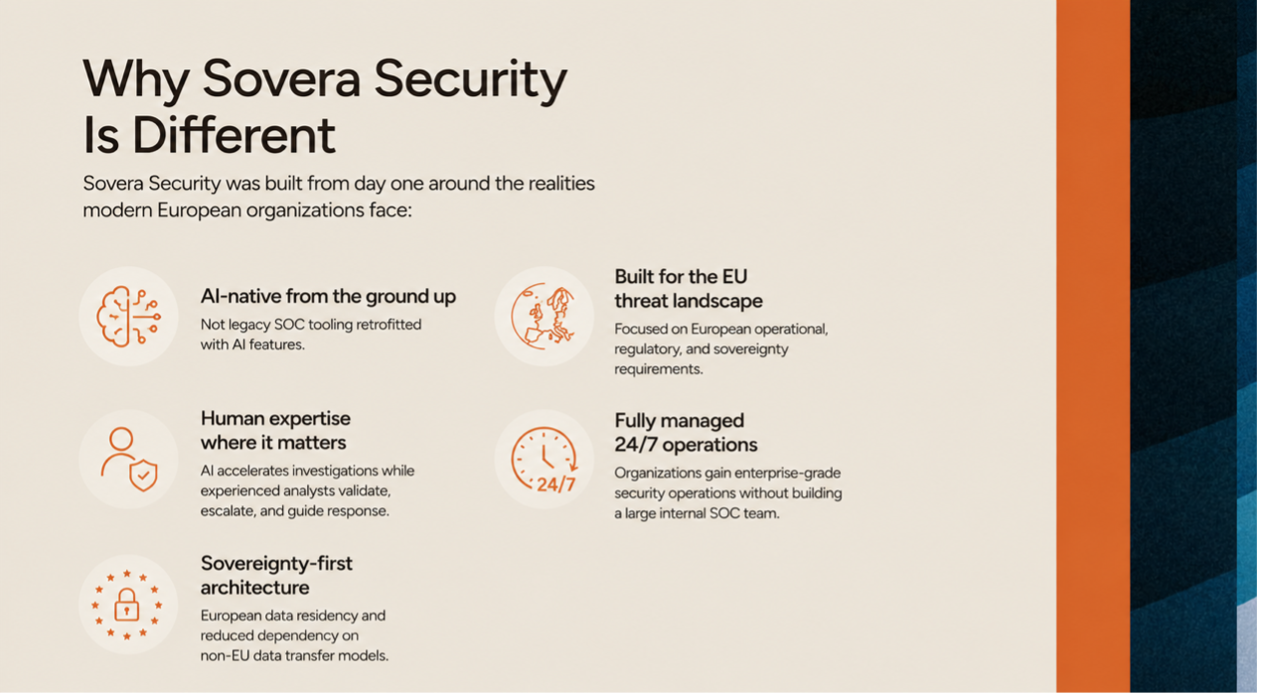
Sovera Security is an AI-native, sovereign MDR platform built from the ground up for European enterprise environments. Headquartered in Copenhagen, Sovera combines agentic AI-driven detection and response with 24/7 analyst coverage, deep GDPR and NIS2 expertise, and European data residency by design. No retrofitted legacy tooling. No dependence on non-European infrastructure.
Ready to find out if your security operations are truly operational?
Sign up for a free assessment at soverasecurity.com. Our team will pressure-test your current stack against real attacker timelines, show you exactly where detections stall before they become a response, and lay out what closing that gap would take.