
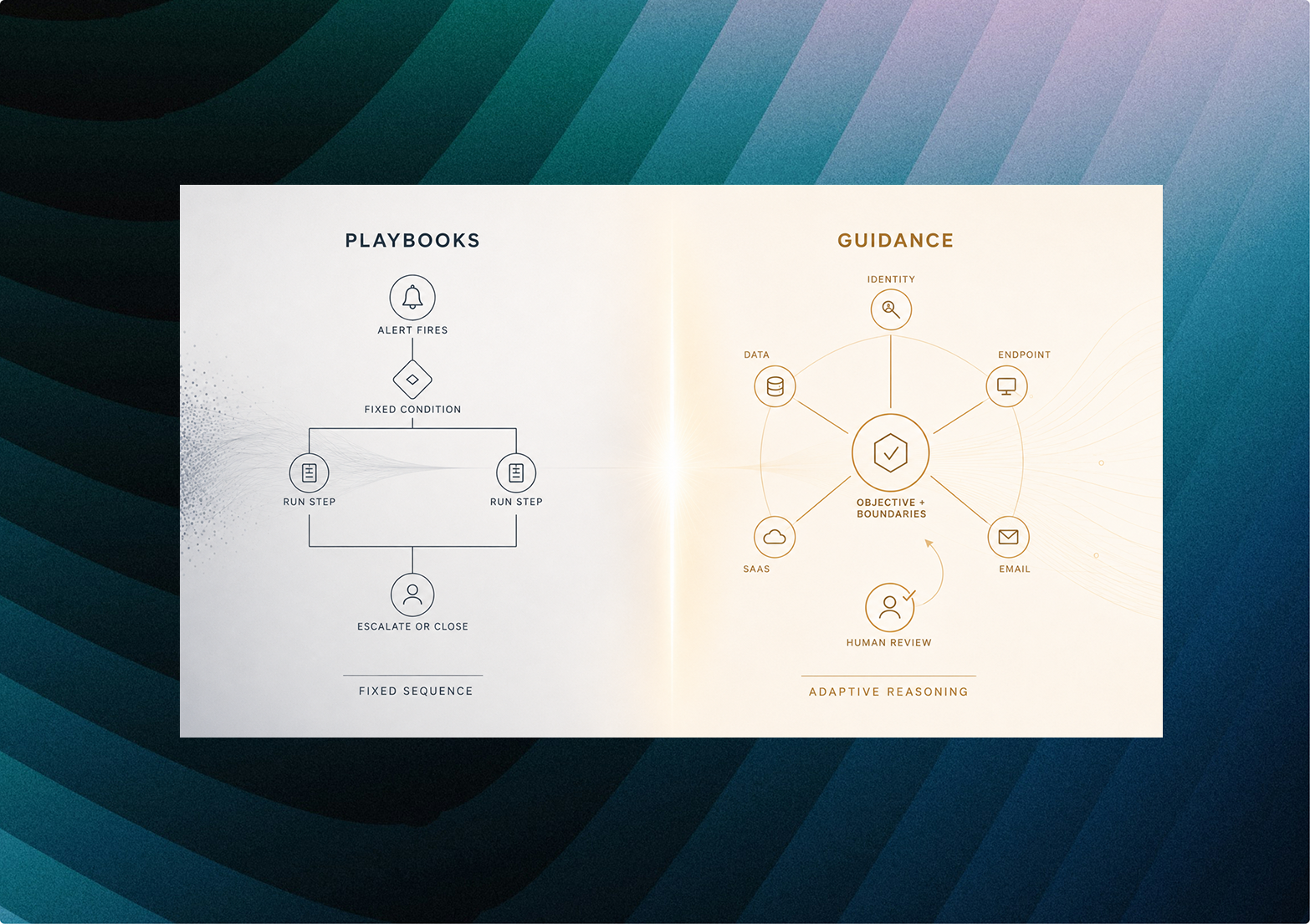
Security automation was built around playbooks for good reason: analysts forget steps under pressure, and traditional tools could only execute what they were explicitly told. So organizations documented every action and escalation path as a structured sequence, i.e. if condition A, check B; if evidence crosses threshold C, do D. That reduced variation and became the foundation for SOARand most early SOC automation.
An AI-native SOC faces a different problem. LLMs hold deep technical knowledge and can reason through situations no playbook author anticipated. Forcing them through rigid run books anyway just turns them into an expensive version of traditional automation. The question isn't how to write a better playbook but how to define work for a system that can reason. The answer is simply guidance.
Why Playbooks Were Necessary
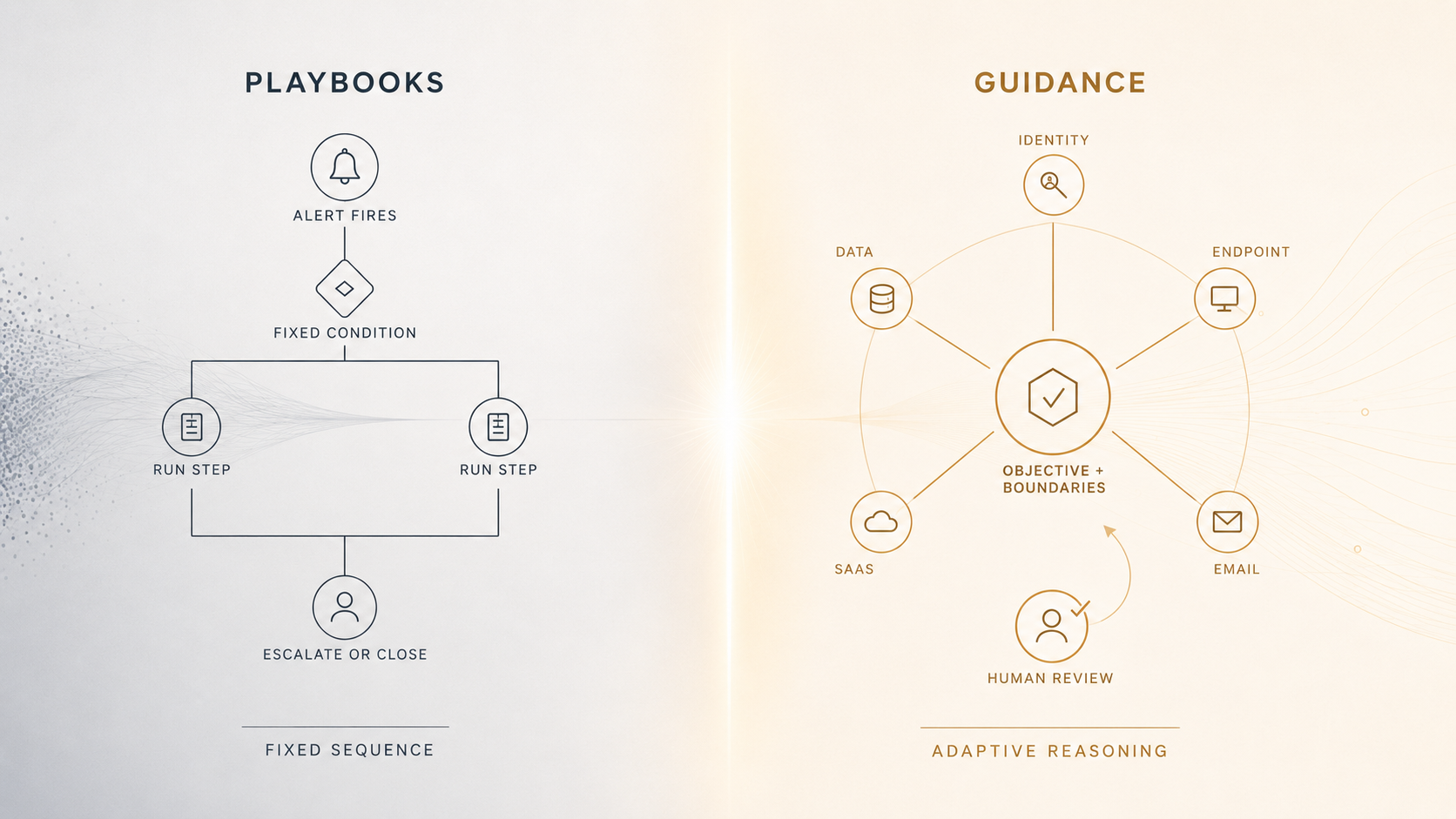
Playbooks solved two problems: human inconsistency, since analysts handle the same alert differently depending on experience, and machine inflexibility, since automation couldn't interpret intent and needed every branch spelled out. A phishing playbook might tell the system to extract URLs, check domain reputation, and quarantine the email if certain indicators appear. This is only useful when the system can't judge what matters on its own. An LLM can instead understand the goal and adapt as findings emerge, though a rigid playbook still limits it to logic reflecting only what its authors knew at the time.
Consider an identity alert for a login from a new geography. A traditional playbook checks IP reputation, impossible travel, and MFA status, then closes the alert if those pass. An AI system may instead notice the same user recently received a suspicious OAuth consent request and accessed an unfamiliar SaaS app. No single signal clears the playbook's threshold, but together they suggest compromise: that a connection the AI would never make confined to the login playbook. The playbook doesn't make it safer, just blinder to context it already has.
Guidance Defines the Objective
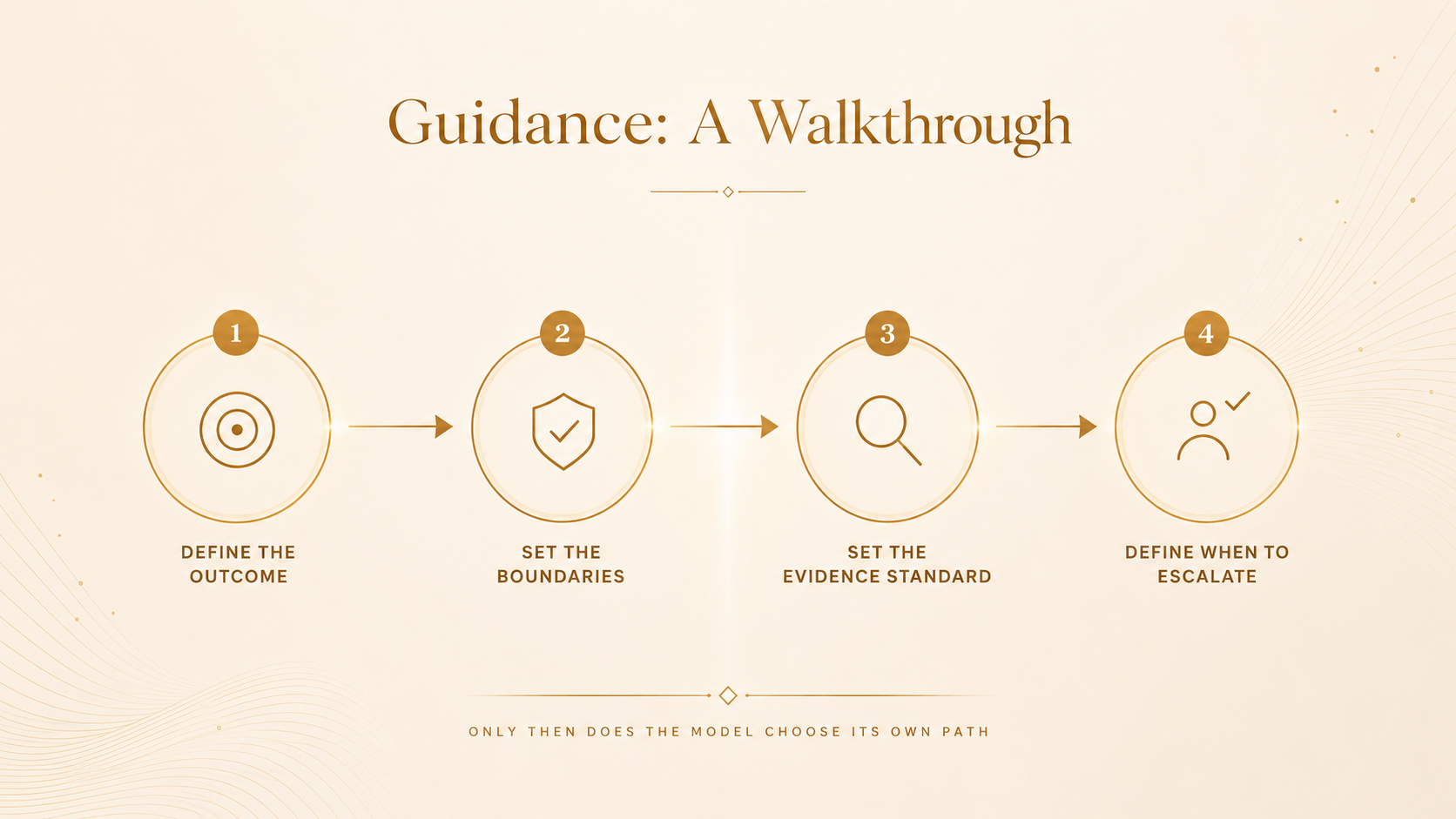
Guidance isn't the absence of process but a different way of defining one. Instead of prescribing every step, it specifies the outcome, the boundaries, the evidence standard, and when human review is required. For an identity investigation, guidance might state:
- Determine whether the activity is consistent with the user's normal behavior and approved business activity.
- Consider authentication, endpoint, email, SaaS, and data-access evidence.
- Do not disable an account based on geolocation alone.
- Escalate before any action that could interrupt executive or production operations.
- Record the evidence that supports and contradicts the conclusion.
This defines what a good investigation must accomplish without forcing a fixed sequence and the model can order its own steps, request more evidence, and adjust as facts change.
Boundaries Matter More Than Instructions
The most important process artifact in an AI-native SOC may be a clear definition of what the system must not do. A capable model can generate many possible actions; the risk is letting it act without sufficient constraints.Investigating malware, it might be allowed to search telemetry and draft a summary, but not isolate a production server without approval, delete files, or close an incident while critical evidence is missing. These boundaries outlast a playbook because they stay useful even as the attack pattern changes.
Guidance Should Define Evidence Quality
AI-native investigations still need standards. A model shouldn't be rewarded for a confident answer alone, it should also show how the evidence supports it. For a suspected exfiltration incident, guidance might require identifying the user involved, the affected assets, the data's sensitivity, and whether the activity was authorized. That keeps the model from treating a plausible narrative as a confirmed incident and gives reviewers a consistent basis for evaluating the work.
Guidance Enables Adaptive Investigation
AI-native investigations still need standards. A model shouldn't be rewarded for a confident answer alone, it should also show how the evidence supports it. For a suspected exfiltration incident, guidance might require identifying the user involved, the affected assets, the data's sensitivity, and whether the activity was authorized. That keeps the model from treating a plausible narrative as a confirmed incident and gives reviewers a consistent basis for evaluating the work.
Playbooks Still Have a Role
Playbooks don't disappear. They remain useful for deterministic actions where consistency matters more than reasoning, like collecting a forensic package or blocking a confirmed malicious hash. What changes is where they sit in the operating model: they should govern repeatable execution, not the entire reasoning process. Guidance governs investigation and judgment; playbooks govern approved mechanical actions. That's ultimately a shift from procedure to intent. A legacy SOC tells the system exactly what steps to follow; an AI-native SOC defines the outcome, the evidence standard, the boundaries, and the points where accountability returns to a person. That isn't less control but a more appropriate form of control for a system that can reason.
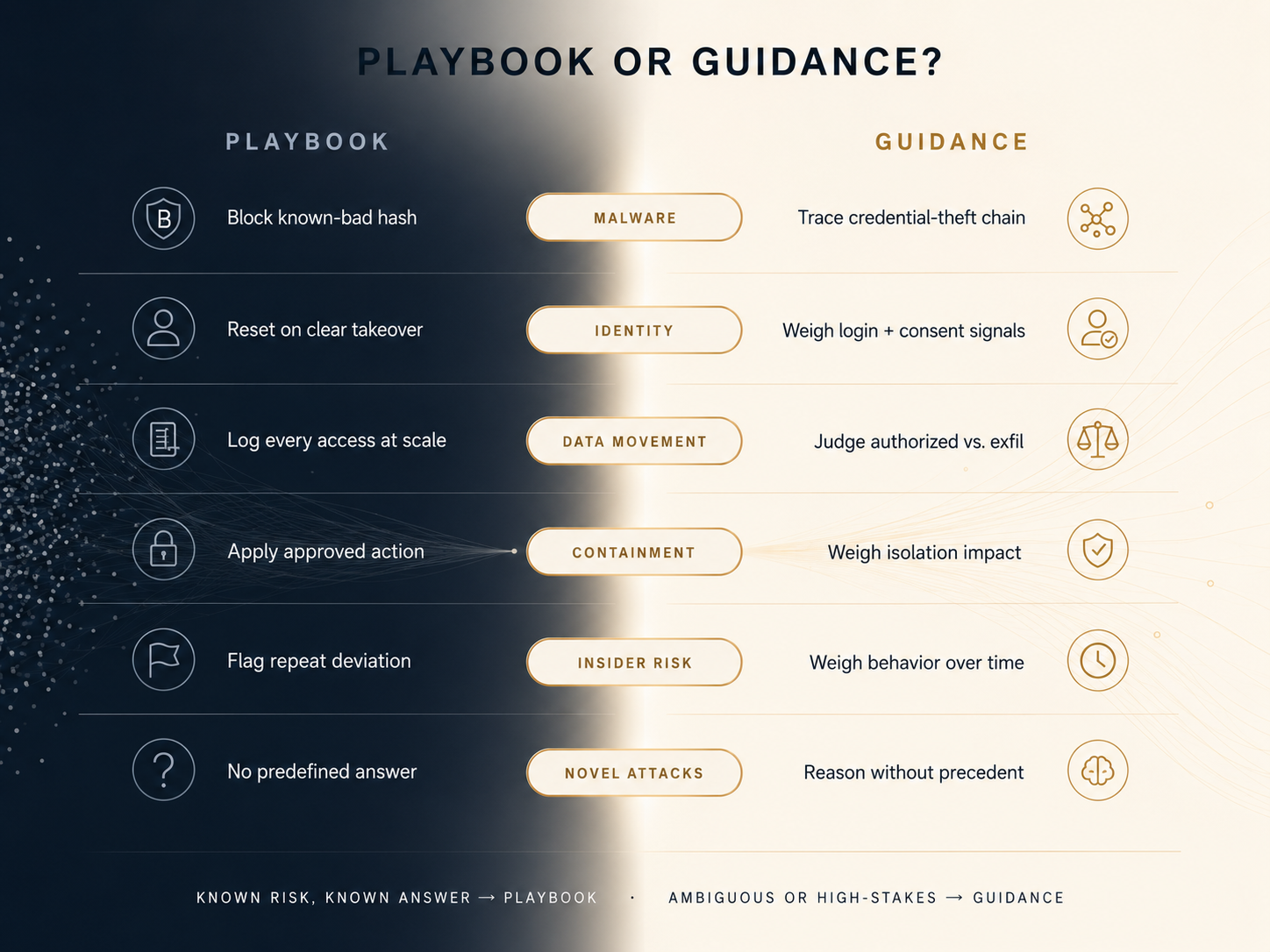
Organizations that get this right won't just automate old run books faster. They'll build processes that let AI investigate broadly, adapt to new evidence, and operate safely within clearly defined limits.