

For years, the cybersecurity industry has repeatedly predicted that SIEM would become a commodity. When EDR emerged, some argued that SIEM would become less important. When Zero Trust gained momentum, similar predictions followed. Now, with AI changing how quickly and cheaply software can be built, SIEM is once again one of the first security categories people expect to be commoditized. This time, however, the argument may carry more weight because AI is changing the underlying economics of security software rather than simply introducing another buzz word.
Building a high-speed data pipeline capable of ingesting, storing, and analyzing enormous volumes of security telemetry is no longer as difficult as it once was. Modern infrastructure can handle millions of events per second, while AI-assisted development reduces the engineering effort required to create parsers, integrations, detection logic, interfaces, and operational workflows. As these capabilities become easier and less expensive to reproduce, organizations will naturally begin questioning why they should continue paying premium prices for functionality that was once technically difficult to build but is becoming increasingly accessible.
The Security Stack Is Becoming Reproducible
SIEM may simply be the first obvious example. The same economic pressure will eventually apply to EDR, IAM, DLP, NDR, and many other parts of the security stack.
Take EDR as an example. Organizations frequently pay for broad operating-system coverage they may not need, large libraries of detection content that may have limited relevance to their environments, and investigation or response functionality that overlaps with other products they already own. Most companies are unlikely to build an entire EDR platform themselves, but increasingly, they may not have to. Smaller vendors will be able to build specialized alternatives at a much lower cost, while internal engineering teams will be able to reproduce individual capabilities that previously required significant product and engineering organizations.
The more important question, therefore, is not whether these products can eventually be replicated. It is when the economics of replication become attractive enough to make replacement practical. That creates a difficult question for every cybersecurity vendor and service provider: if AI allows us to automate more of our own engineering and security work, what prevents customers from eventually using the same technology to reproduce some of the value they currently purchase from us?
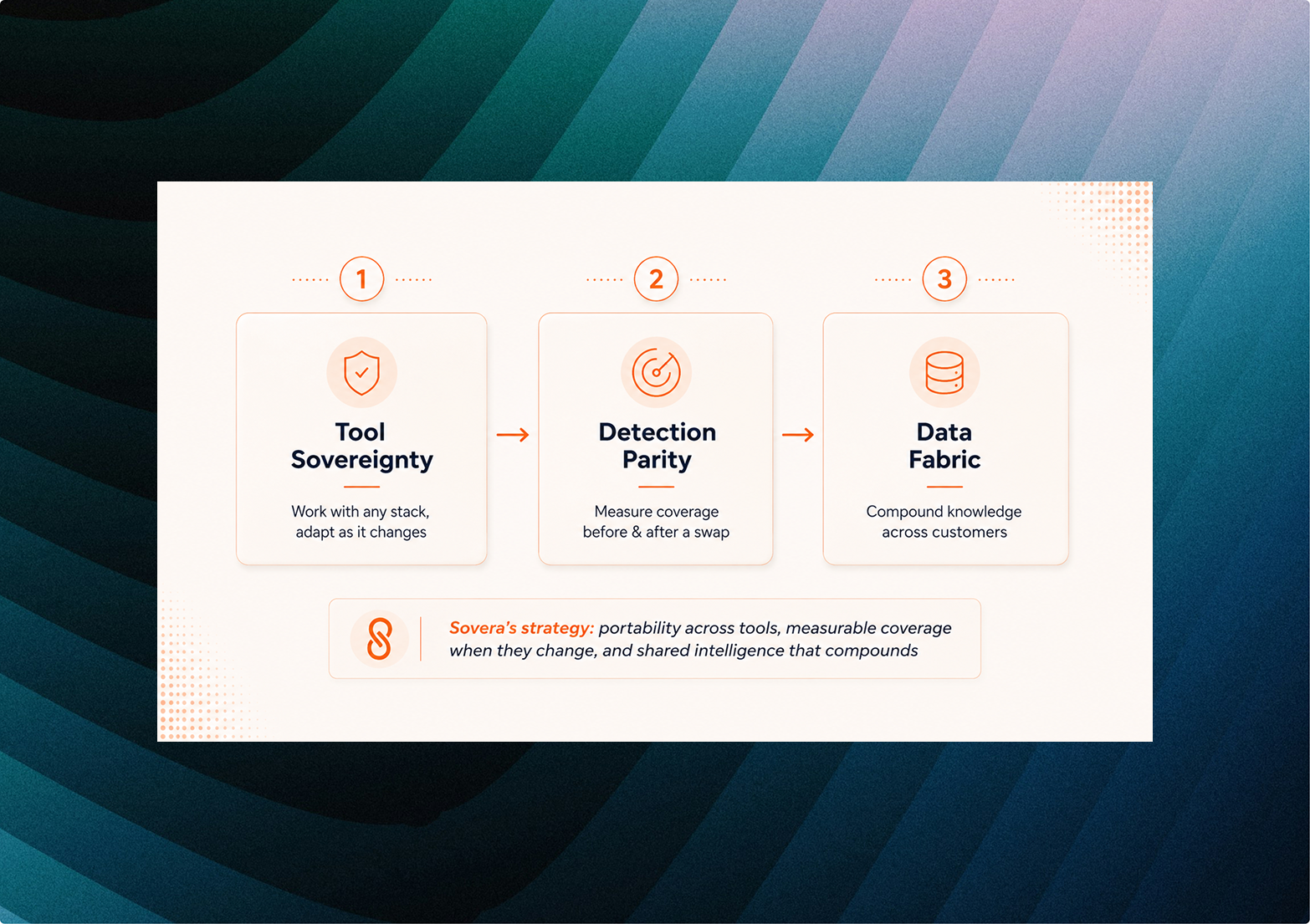
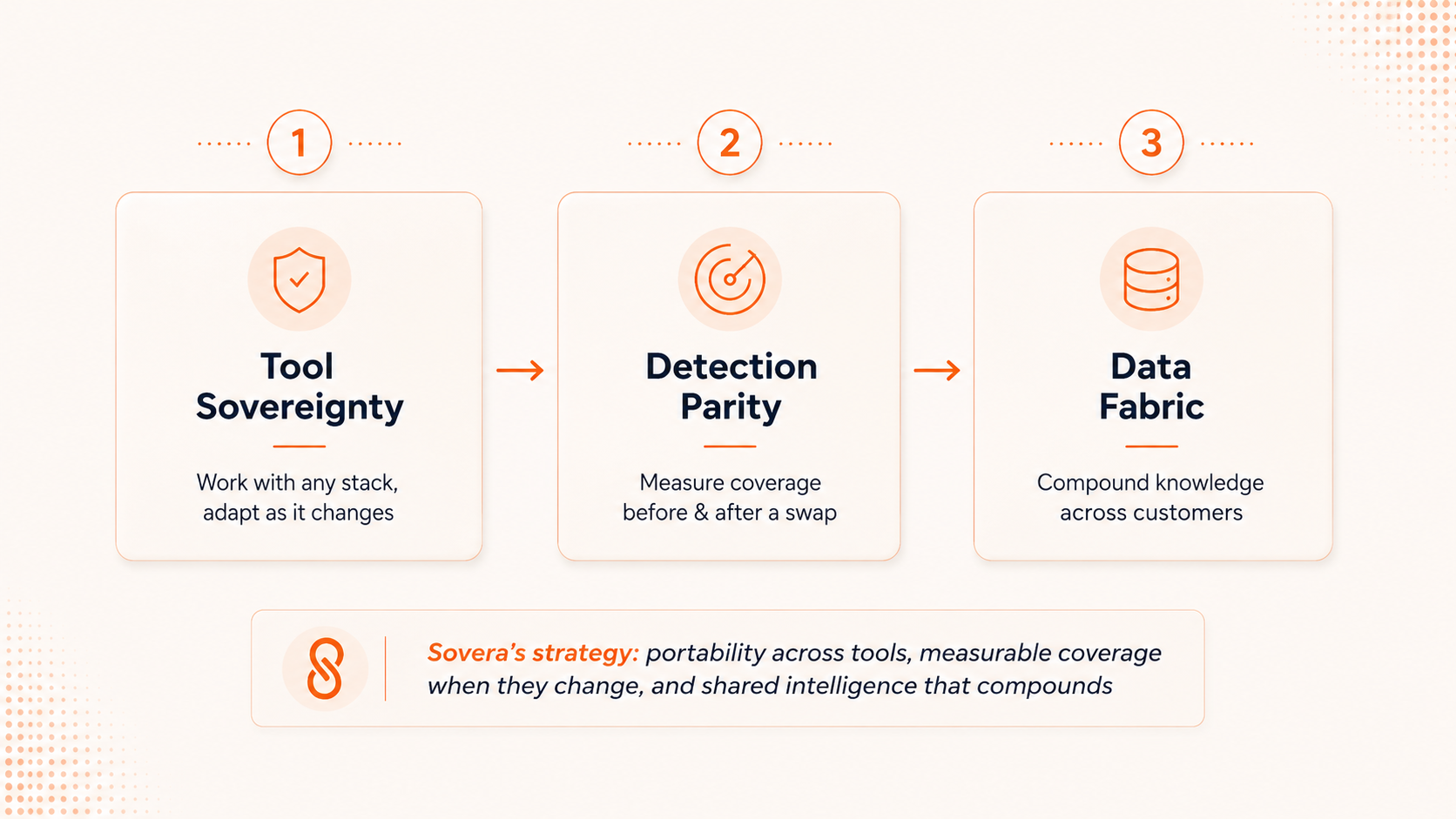
At Sovera Security, we believe the right response is to design for that future rather than avoid the reality. Our approach centers on three principles: Tool Sovereignty, Detection Parity, and Data Fabric.
Tool Sovereignty
Tool Sovereignty begins with the idea that customers should retain control of their security architecture. Sovera is designed to operate across a customer's existing SIEM, EDR, IAM, DLP, NDR, and other security technologies, but just as importantly, it is designed to accommodate those products being replaced over time.
Historically, supporting a broad range of security technologies was expensive. Every new integration required engineers to understand proprietary APIs, create connectors, develop parsers, normalize data schemas, maintain mappings, and continuously update them as vendors changed their products. AI significantly changes those economics. As building and maintaining integrations becomes faster and less expensive, supporting a heterogeneous and constantly changing security stack becomes a much more practical engineering model.
That flexibility is important because customers should not be forced to retain an expensive SIEM, EDR, or other platform simply because replacing it would disrupt their broader security operation. If a better, cheaper, or more specialized technology becomes available, organizations should be able to adopt it without redesigning everything surrounding it. The security provider's role should be to make the underlying architecture more portable, not to create additional dependencies that make customers afraid to change it.
Detection Parity
Greater tool flexibility, however, introduces another problem. Replacing a security product is not simply a technical migration because the real question is whether the organization remains equally protected afterward. When replacing an EDR, for example, security teams need to know which detections will continue to function, which capabilities will disappear, which rules need to be rewritten, and whether the new technology introduces previously nonexistent blind spots.
This is where Detection Parity becomes critical. Rather than relying on a subjective assumption that two products provide roughly equivalent protection, organizations should be able to measure how detection coverage changes before and after a migration. If a company discovers an EDR that provides comparable protection at half the cost, it should be able to evaluate that decision based on evidence. Likewise, if an internal engineering team wants to replace a commercial SIEM with an internally developed platform, security leadership should be able to determine exactly what coverage would be retained, lost, or improved.
The broader goal is to separate security outcomes from individual products. A change in technology should not automatically produce an unknown change in security posture. As replacement becomes more common, the ability to measure detection parity will become increasingly important to making those transitions safely.
Data Fabric
Eventually, the same commoditization argument will extend beyond security software and into security services. If AI becomes highly capable at investigating alerts, correlating events, analyzing malware, generating recommendations, and automating response, organizations will reasonably begin asking why they should continue paying for traditional MXDR and managed security services. Every cybersecurity service provider, including Sovera, will eventually need to answer that question.
There is, however, an important distinction between reproducing software capabilities and reproducing real-world observations. AI can generate code, build integrations, analyze incidents, summarize threat intelligence, and replicate many operational workflows. What it cannot manufacture is an observation that has never happened. An individual organization can only see activity occurring within its own environment. It cannot independently know that the same infrastructure appeared in attacks against several other companies yesterday, that a new technique is suddenly spreading across an industry, or that an unknown file hash has begun appearing in otherwise unrelated incidents.
Even extremely capable AI requires real observations as input, which is why we believe an increasingly important source of long-term security value will be the data fabric connecting organizations, detections, incidents, and threat intelligence. When security knowledge can be exchanged across environments in a trustworthy way, its value compounds. An incident observed at one organization can improve protection elsewhere. A detection created for one environment can reveal a coverage gap in another. Infrastructure associated with an attack against one customer can help identify suspicious activity for another before an incident fully develops.
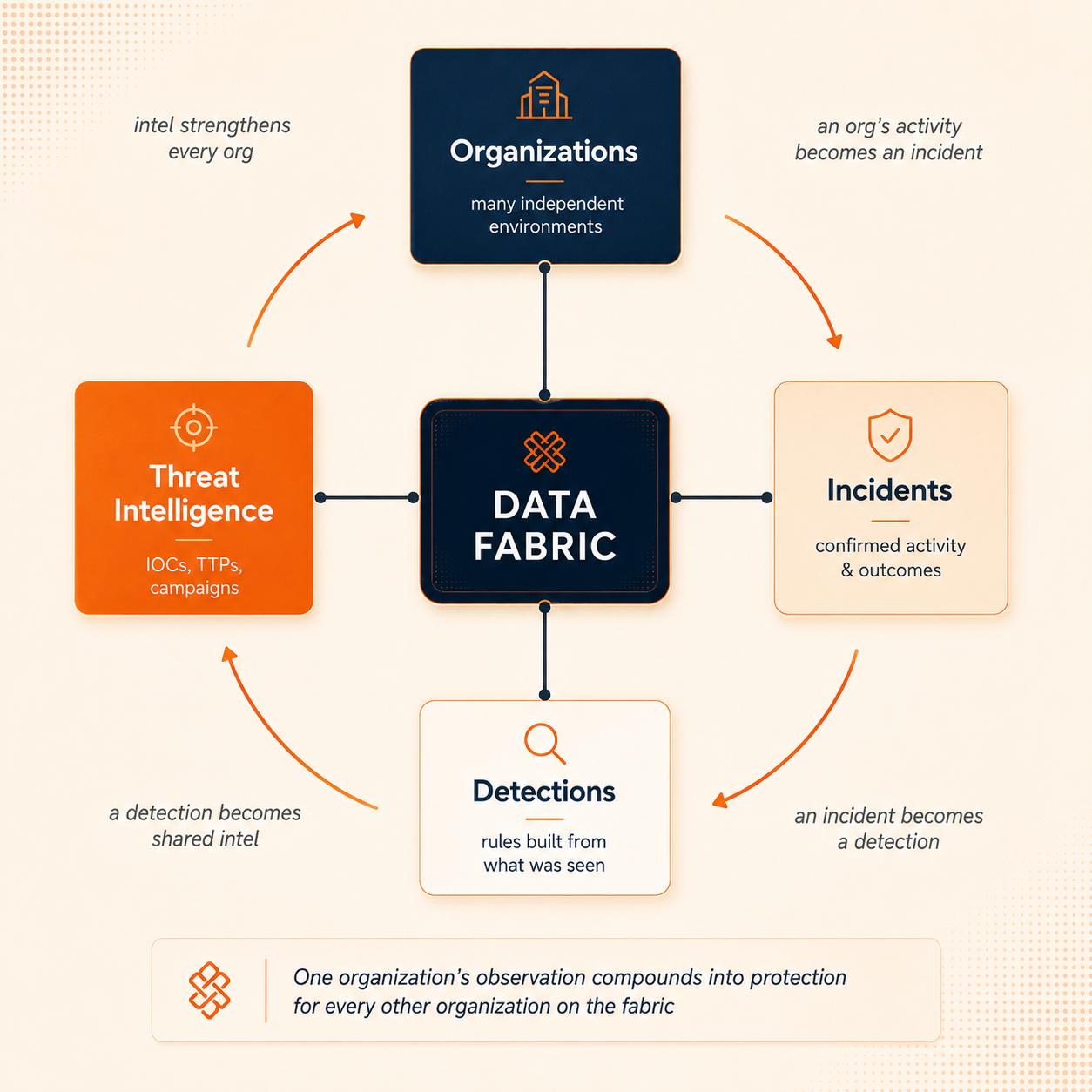
The value of this model is not simply access to more data. It is the ability to turn independent observations into collective security knowledge that no individual organization could generate on its own.
Preparing for a Replaceable Security Stack
At Sovera, we are preparing for a cybersecurity market in which replacement becomes normal rather than exceptional. Organizations will continually reassess whether their existing tools justify their costs, while AI will make it easier for new vendors, specialized technologies, and internally developed alternatives to enter the market. Tool Sovereignty allows customers to make those changes without creating unnecessary architectural dependencies, while Detection Parity provides a way to evaluate whether those changes preserve security outcomes. Data Fabric then creates a layer of shared knowledge that remains valuable regardless of which individual technologies sit underneath it.
There is an important consequence to this philosophy. If we successfully help customers replace other security vendors, eventually customers should ask whether they can replace Sovera as well. We believe that is a healthy question. Every vendor should continually earn its position in the security stack rather than relying on technical dependencies or switching costs to preserve it.
AI will make software increasingly reproducible, expertise increasingly accessible, and many of today's security capabilities easier to rebuild. In that environment, the most defensible cybersecurity companies will not be those that make themselves difficult to replace. They will be the ones that continue to provide meaningful value even when replacement becomes easy.