
At his ICM 2026 public lecture, Terence Tao described mathematics entering an era of proof abundance rather than proof scarcity. If AI can generate correct proofs faster than mathematicians can absorb them, the bottleneck stops being generation and becomes digestion: deciding what is correct, what matters, and how it fits into the field’s shared understanding.
Cybersecurity is heading toward the same inflection point. For decades, the SOC has operated under scarcity: too many alerts, too little correlation, and too few analyst-hours. Most modern security tooling has therefore been designed to help scarce human analysts move faster. AI changes that constraint. An agent can generate hypotheses, query systems, weigh evidence, and act at a speed no human team can match. The question is no longer simply how to produce more analysis. It becomes how to turn a flood of machine-generated analysis into decisions that can be trusted, governed, and defended.
.png)
This is why Anton Chuvakin’s warning against “building a 2003 SOC with AI” matters. Bolting an agent onto every step of the existing analyst workflow misses the real shift underway, which is a redistribution of where humans sit in the system.
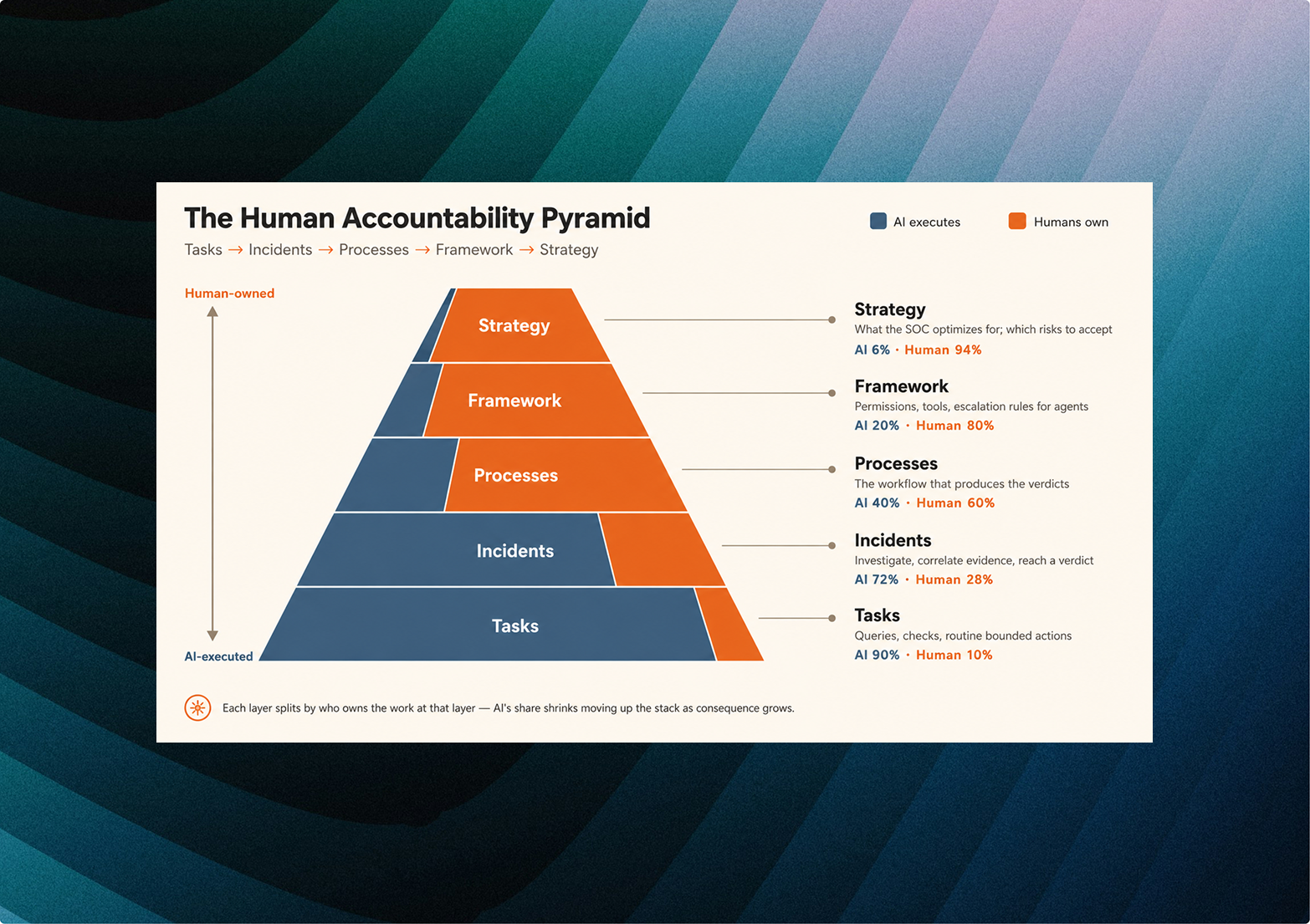
Humans will not disappear from the loop. They will move up it. Picture a pyramid: at the base is an enormous number of bounded, low-consequence decisions, while near the top there are far fewer decisions, each with a much greater blast radius. AI increasingly owns the base, while humans own the top and define how the base is allowed to operate.
Layer 1: AI Runs the Operational Floor
Most of what fills an analyst’s day, including querying identity logs, checking a domain against threat intelligence, correlating events, or blocking a known malicious indicator, is repetitive and well bounded. Requiring human sign-off on every such action adds friction without necessarily adding meaningful control.
The human role therefore shifts earlier in the process. Humans decide what an agent can see, what credentials it holds, and which actions are consequential enough to require escalation. Removing a phishing email and isolating a production server are not equivalent decisions, even if a model classifies both as response actions. Humans define that distinction, while the agent operates autonomously within the boundaries they establish.
Layer 2: Humans Own the Process, Not Every Verdict
When an AI system gets something wrong, such as repeatedly missing account takeovers because it never considers credential stuffing, fixing that one case is not enough. The same blind spot can recur across thousands of future investigations unless someone identifies the source. The problem might be an instruction, a missing data feed, a retrieval gap, an integration issue, or a flawed branch in the workflow.
This creates a much more scalable form of oversight. One analyst catching one bad verdict improves one incident. An analyst who identifies and corrects a systemic weakness improves every future investigation that would otherwise have repeated the same mistake. As autonomous volume grows, this is where human judgment becomes most valuable.
Layer 3: Humans Govern the System That Governs the Agents
Every agent operates inside a framework of permissions, tools, escalation rules, safeguards, and policies. As AI systems become more capable, they will increasingly identify limitations in that framework themselves and may correctly conclude that broader credentials or fewer approval gates would make them more effective.
That does not mean they should be able to grant those permissions to themselves. A system that can expand its own authority, weaken its own safeguards, or redefine the rules governing its behavior creates a fundamental governance problem, regardless of how sound its reasoning may be.
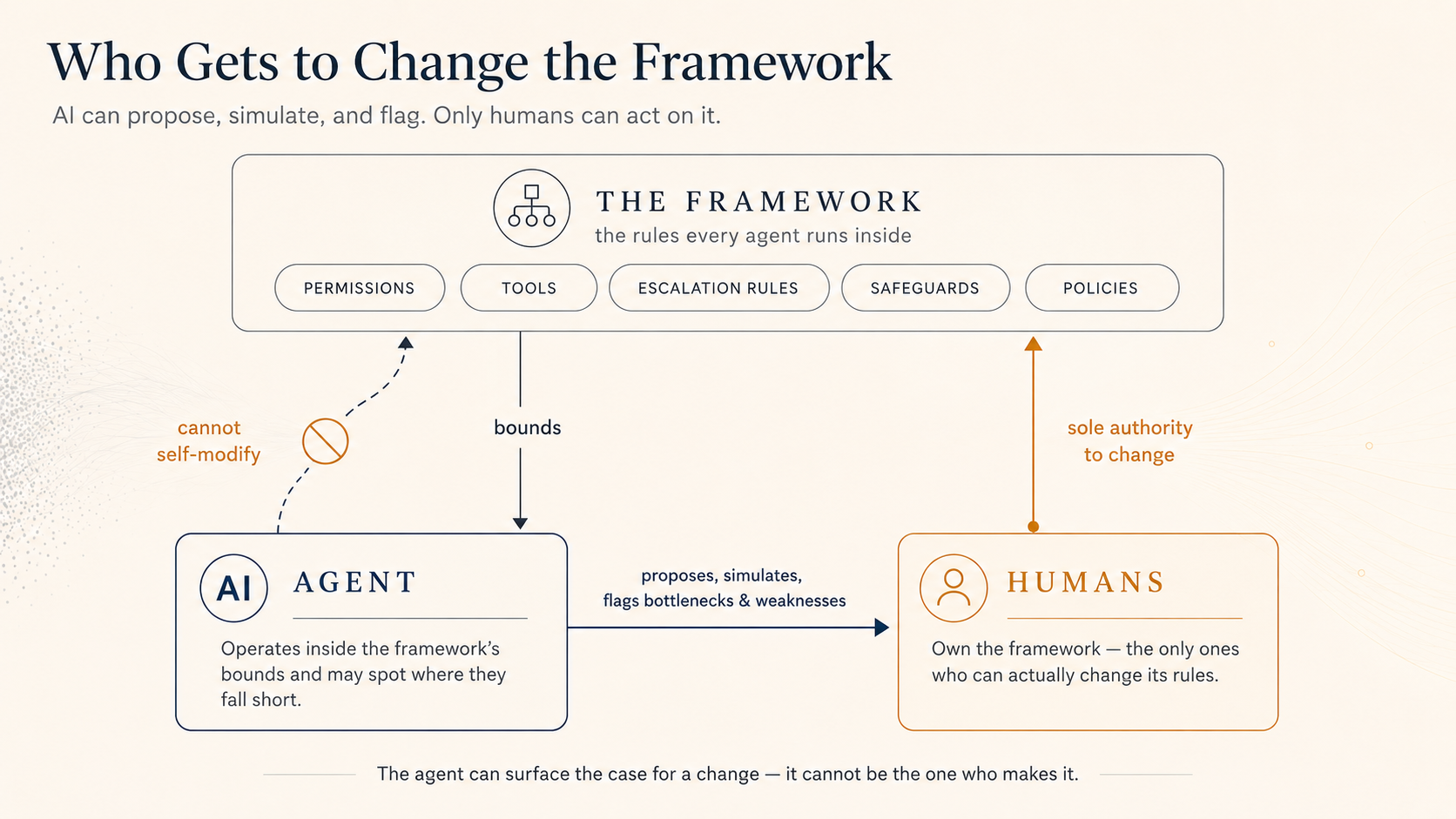
AI can propose changes, simulate their effects, identify bottlenecks, and flag weaknesses. The authority to alter the framework itself, however, should remain independently owned by humans.
Layer 4: Model Choice Is a Governance Decision, Not Routine Maintenance
Different models can behave very differently when presented with identical evidence. Some may chase too many false leads, while others converge too quickly. Some may handle incomplete information well but be more vulnerable to manipulation. These differences matter because the underlying model influences how every workflow built on top of it reasons.
Replacing a conventional software component is often routine maintenance. Replacing the model underneath an agentic SOC can be far more consequential because it may change the behavior of the entire system without anyone modifying the surrounding process or policy layer.
AI can continuously benchmark models, compare performance, and route work toward the best option for specific tasks. For lower-risk workflows, that degree of automation may soon become routine. For high-impact decisions, however, allowing the system to choose its own successor introduces a recursive governance problem. Humans should continue to own the criteria for adopting or replacing the models that influence consequential security decisions.
Layer 5: Humans Decide What the SOC Is Optimizing For
At the top of the pyramid, the question is no longer execution. It is objectives. Every SOC operates under real constraints, including budget, headcount, risk tolerance, regulatory exposure, infrastructure costs, and operational priorities. AI can help identify waste, model tradeoffs, and show where additional controls are likely to produce the greatest marginal benefit.
What AI should not determine independently is which risks are worth accepting. Two organizations with nearly identical technical environments may rationally choose very different security postures because the business consequences of failure are different for each of them. That is not simply a modeling problem. It is a strategy problem.
Security strategy reflects business priorities, regulatory obligations, customer expectations, financial constraints, and organizational risk appetite. Those decisions remain human because they determine not merely how the SOC operates, but what the organization is ultimately willing to protect, spend, and risk.
The Shift Is Upward, Not Away
As AI takes on more of the SOC’s operational work, humans will become less visible at the level of individual queries, verdicts, and containment actions. That is not necessarily a problem. What matters is that accountability does not shrink along with that visibility. It relocates.
Instead of approving one query, humans define which categories of queries are safe to automate. Instead of correcting one verdict, they improve the process responsible for producing thousands of verdicts. Instead of supervising every response action, they govern the framework that determines when autonomous response is permitted. Instead of selecting every model manually, they define the standards under which model changes are acceptable. At the highest level, they determine the objectives and risk tradeoffs the entire system is meant to serve.
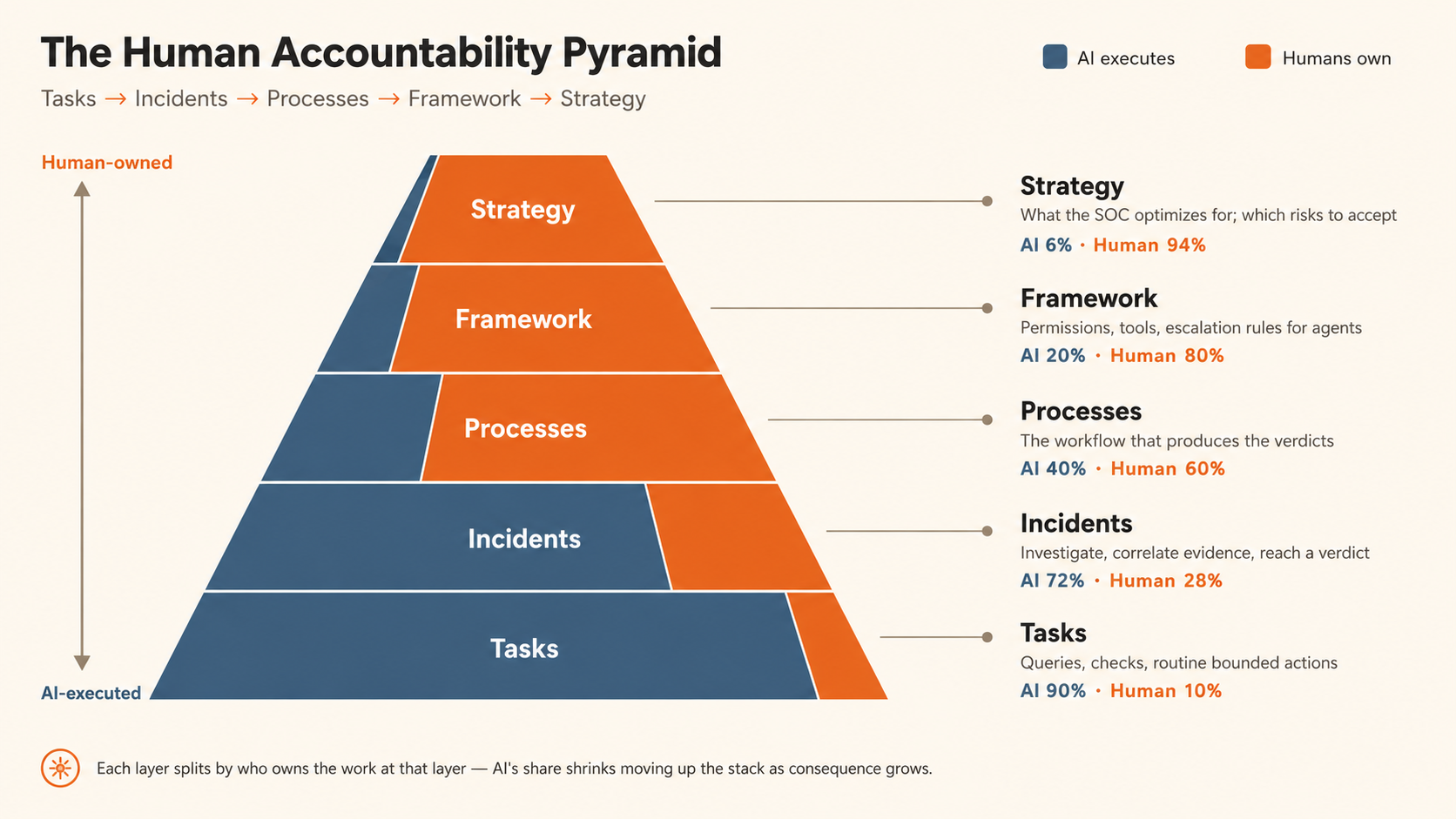
“Human in the loop” was a useful phrase for a world in which machines largely assisted human decision-makers. An AI-driven SOC requires a broader concept. Humans may no longer sit inside every operational loop, but they remain responsible for the structure around those loops, the authority granted to the systems operating within them, and the consequences that follow.
The future SOC is therefore better understood as a pyramid of accountability. AI occupies the broad base, executing the enormous volume of routine work that can be safely bounded and automated. Humans sit progressively higher in the structure, taking responsibility for process design, governance, model selection, and strategy. Their role becomes less frequent at the task level but more consequential at the system level, because the decisions made at the top determine how everything beneath them is allowed to operate.