
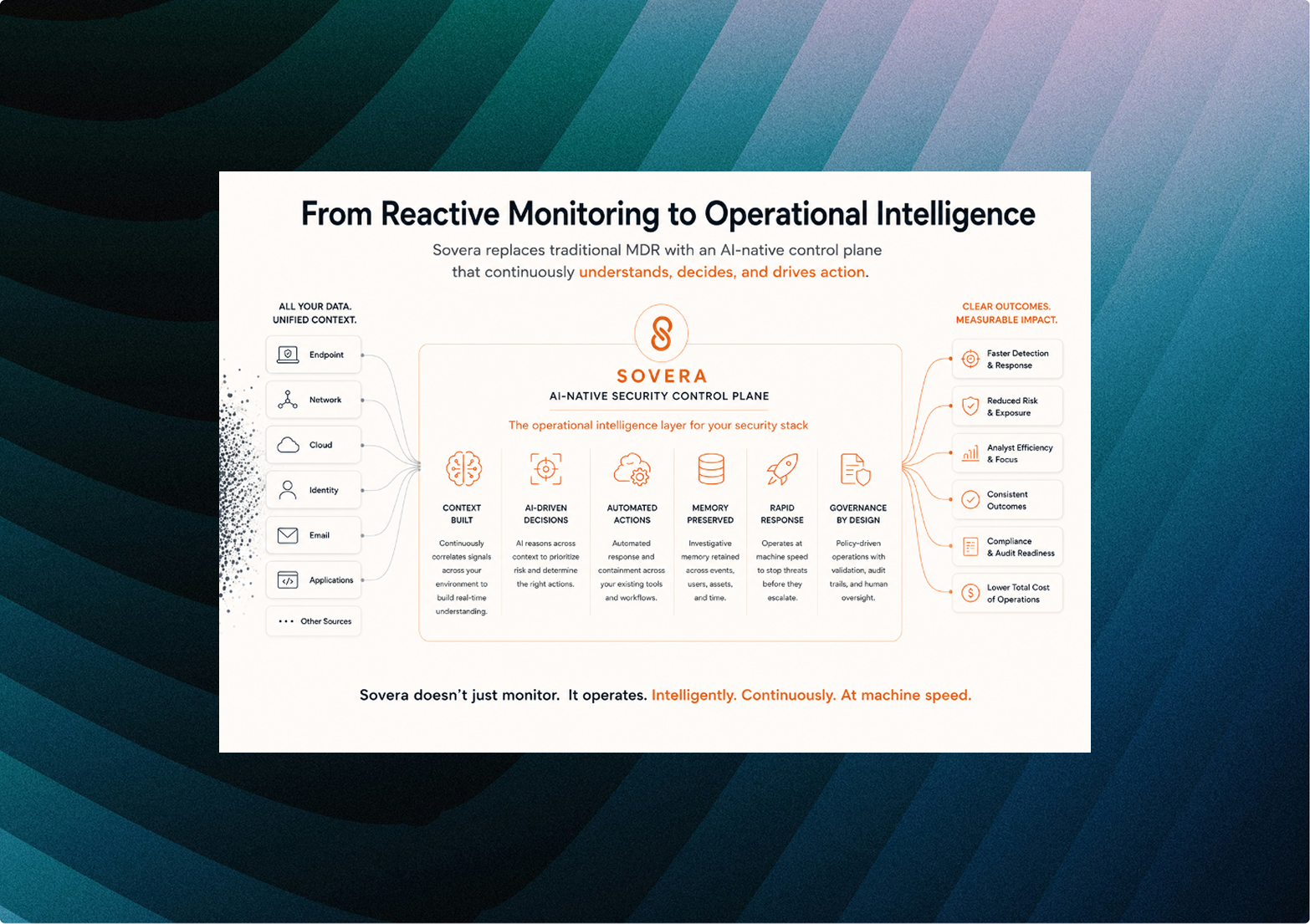
You have endpoint monitoring, 24/7 SOC coverage, SIEM integrations, and a stack of detection platforms. You’ve made the investments. You’ve checked the boxes. And yet something still feels broken.
Incidents take too long to investigate. Analysts are buried in alerts with no context. Tools don’t talk to each other the way they should. The uncomfortable truth: the problem isn’t your security stack. It’s the operational layer that’s supposed to tie it together.
The Limits of Traditional MDR
Legacy MDR was built around endpoints, human-heavy analyst workflows, and reactive alert escalation. That model worked for a simpler threat landscape. Today it’s showing its age. The challenges are familiar:
● Too many escalations without operational context
● Slow remediation and siloed tooling
● Analyst burnout from alert overload
● Compliance and sovereignty gaps
● No clear path to operationalizing AI securely
Layering AI on top of the same escalation queues doesn't change what's driving the burnout. Analysts are still the ones stitching alerts together by hand, jumping between five consoles, and carrying investigative context in their heads because the workflow was never redesigned around AI in the first place. That burden doesn't shrink just because a chatbot got added to the stack.
Your Tools Are Underperforming: Not Because They’re Weak, But Because They’re Isolated
Most enterprises already own genuinely powerful technology: i.e. Sentinel, Splunk, CrowdStrike, Defender, Okta. The investment is real. But owning powerful tools and operationalizing them are two completely different things.
Without an intelligent coordination layer above your stack:
● Your SIEM becomes an expensive, noisy data lake nobody trusts
● Your EDR surfaces so many alerts that analysts stop reading them carefully
● Identity anomalies get flagged without business context to judge their severity
● Investigations fragment across six consoles, losing thread every time they’re handed off
The result: a security operation that detects plenty of things and acts decisively on very few of them. That gap between detection and response is exactly where breaches happen.
From Reactive Monitoring to Operational Intelligence
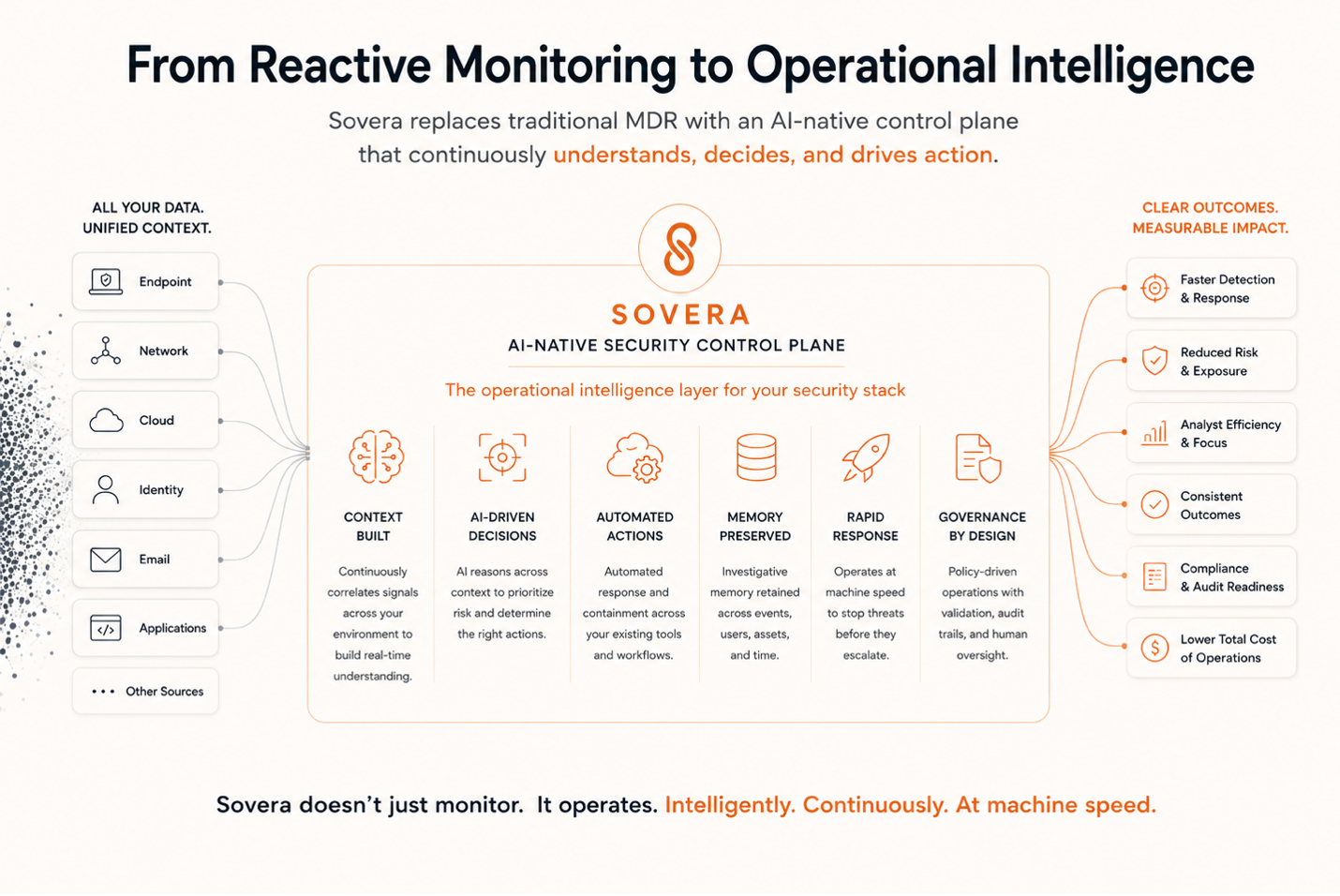
Traditional MDR platforms are sophisticated monitoring systems. They watch, alert, escalate. The burden of connecting the dots such as correlating signals, maintaining investigative context, deciding what matters still falls on human analysts working manually.
The next generation of security operations needs to function as a control plane: an intelligent layer that continuously correlates telemetry, maintains context across investigations, surfaces what requires human attention, and learns from every incident.
"AI-powered" and "AI-native" get used interchangeably in vendor decks. They shouldn't be as one is a feature bolted on, the other is how the system is built.
In practice, that means the machine handles the mechanical layer (normalization, enrichment, correlation, deduplication, prioritization) continuously and in the background. What's left for analysts is the part that actually needs a human: judgment calls on ambiguous or high-stakes decisions.
What Is Sovereign MDR and Why It Matters Now
AI-native is necessary. But it’s not sufficient. The next question is: who controls the platform?
Sovereign MDR rests on the same four pillars regardless of provider: telemetry and case data never leave the jurisdiction you define, your organization (not the vendor), decides which AI models touch your data and where they run, no single tool or model provider can hold your operations hostage, and the whole stack has to run wherever you need it: cloud, on-prem, hybrid, or air-gapped. We break down each of these in detail here; the version that matters for a switching decision is simpler: if you can't answer where your data sits and who can pull the plug on the AI, you're not evaluating a sovereign platform.
What Switching Actually Looks Like
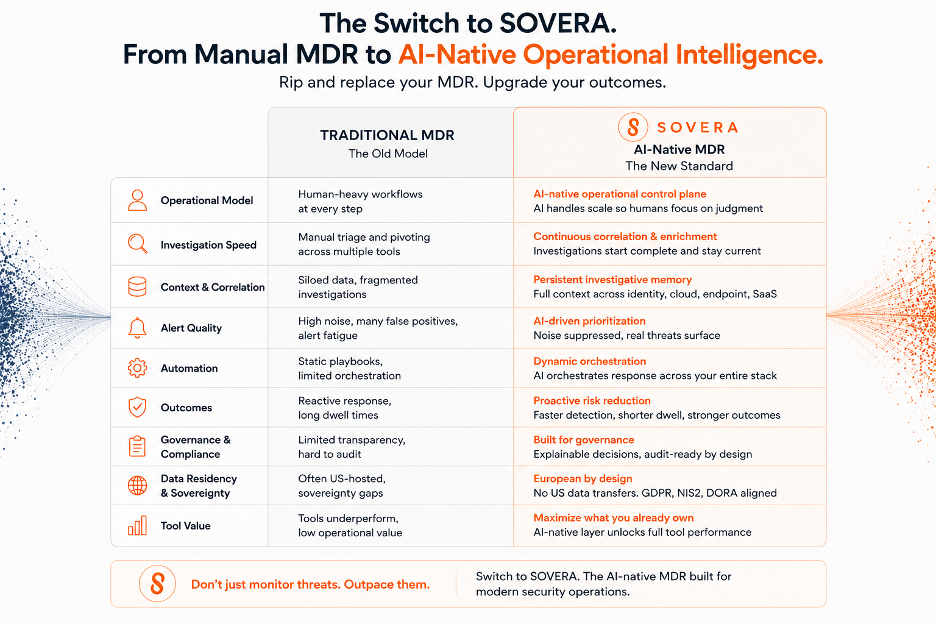
Replacing your MDR provider doesn’t mean ripping out your security stack. Your existing tools stay. What changes is the operational layer above them.
With Sovera, your existing platforms become coordinated. Alerts arrive with context already attached. Investigations don’t fragment across tool boundaries. Response timelines compress not because you hired more people, but because the operational work slowing everything down is handled automatically.
Where most MDR providers stop at detection and escalation, Sovera takes over the workflows that fall through the cracks: correlating telemetry across identity, cloud, SaaS, and endpoints; enriching investigations automatically; providing the business and regulatory context that makes remediation faster.
Five Reasons to Move to Sovera
1. Faster, more contextual investigations. Investigations begin with full context already assembled — identity, endpoint, cloud, SaaS, and network correlated before an analyst touches the case.
2. Operational scale without headcount growth. Automated correlation, enrichment, and investigation workflows scale security operations without scaling analyst fatigue.
3. Human-governed autonomous response. AI handles operational scale. Humans remain in control of governance and business-critical decisions.
4. Better outcomes from tools you already own. Fragmented telemetry becomes a coordinated defense platform — faster detection, reduced dwell time, improved response consistency.
5. Operational in hours, not months. Sovera integrates directly into your existing environment. No stack replacement, no infrastructure redesign.
For European Organizations, There’s Another Dimension
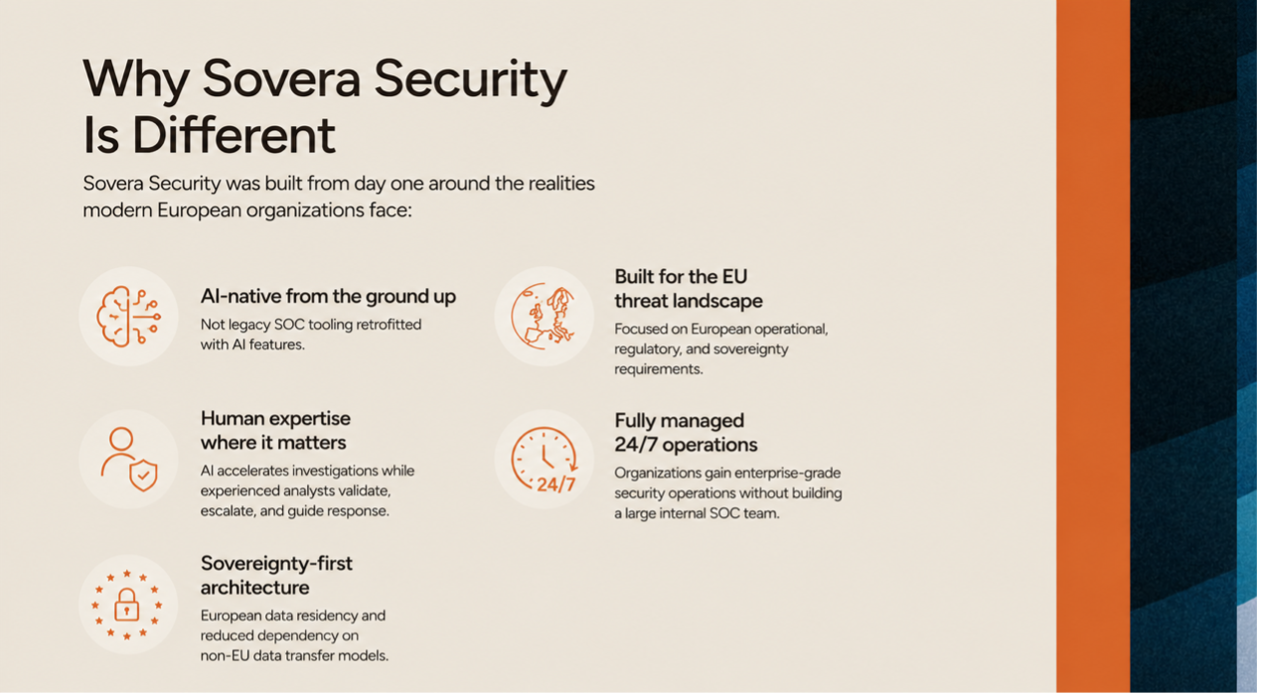
Most MDR providers were built for the US market. That means telemetry processed outside the EU, offshore analyst teams, and a governance model that doesn’t naturally align with GDPR, NIS2, or DORA. That misalignment used to be a compliance footnote. It’s now a boardroom issue.
European security leaders now face direct questions:
● Where is our security telemetry stored, and under whose jurisdiction?
● Can our MDR provider demonstrate NIS2 and GDPR governance controls?
● Can the provider operate entirely within EU jurisdiction including AI inference and model usage?
● How quickly can incidents be identified, contained, and reported to regulators?
Sovera was built with European sovereignty as a first principle. Data residency, explainable AI workflows, auditable operations, and regulatory alignment aren’t add-ons: they’re baked into the architecture from the ground up. At machine speed, governance doesn’t become less important. It becomes the thing that makes the whole system trustworthy.
About Sovera Security
Sovera Security is an AI-native, sovereign MDR platform built from the ground up for European enterprise environments. Headquartered in Copenhagen, Sovera combines agentic AI-driven detection and response with 24/7 analyst coverage, deep GDPR and NIS2 expertise, and European data residency by design. No retrofitted legacy tooling. No dependence on non-European infrastructure.
Ready to find out what’s falling through the cracks?
Sign up for a free assessment at soverasecurity.com. Our founding team will map your current stack against modern threat patterns, identify where your detection-to-response loop breaks down, and show you exactly what needs to change.