
What keeps CISOs awake at night isn't always the incidents under active investigation. It's the ones already closed, downgraded, or deprioritized because they looked harmless at the time.
Every SOC runs on prioritization and there are always more alerts than analysts can investigate thoroughly. That's an unavoidable reality. But the incidents a SOC waves through as low-risk aren't necessarily noise. They may be its most valuable untapped threat intelligence.
The Triage Problem
An analyst reviews an incident tied to a software update, checks the process tree, validates the command-line arguments, and concludes the behavior looks like legitimate admin activity. Case closed as a false positive. Based on the evidence in front of them, that call is often perfectly reasonable.
What rarely happens next: checking whether the same executable showed up on other endpoints, whether similar commands ran outside the maintenance window, or whether unusual identity or network activity preceded it. That takes time, history, and data scattered across tools most SOCs don't have to spare.
The Cost of Deprioritizing
So deprioritization becomes a necessity, not a statement of certainty. Every closed case becomes part of an accumulating archive: weak signals, incomplete investigations, attacker behavior that never crossed a threshold.
What the SOC treats as garbage may be some of its most valuable threat intelligence if anyone ever goes back to look.
Traditional SOC workflows treat incidents as discrete units: enrich, group, assign severity, investigate, close. Once closed, an incident exits the workflow entirely.
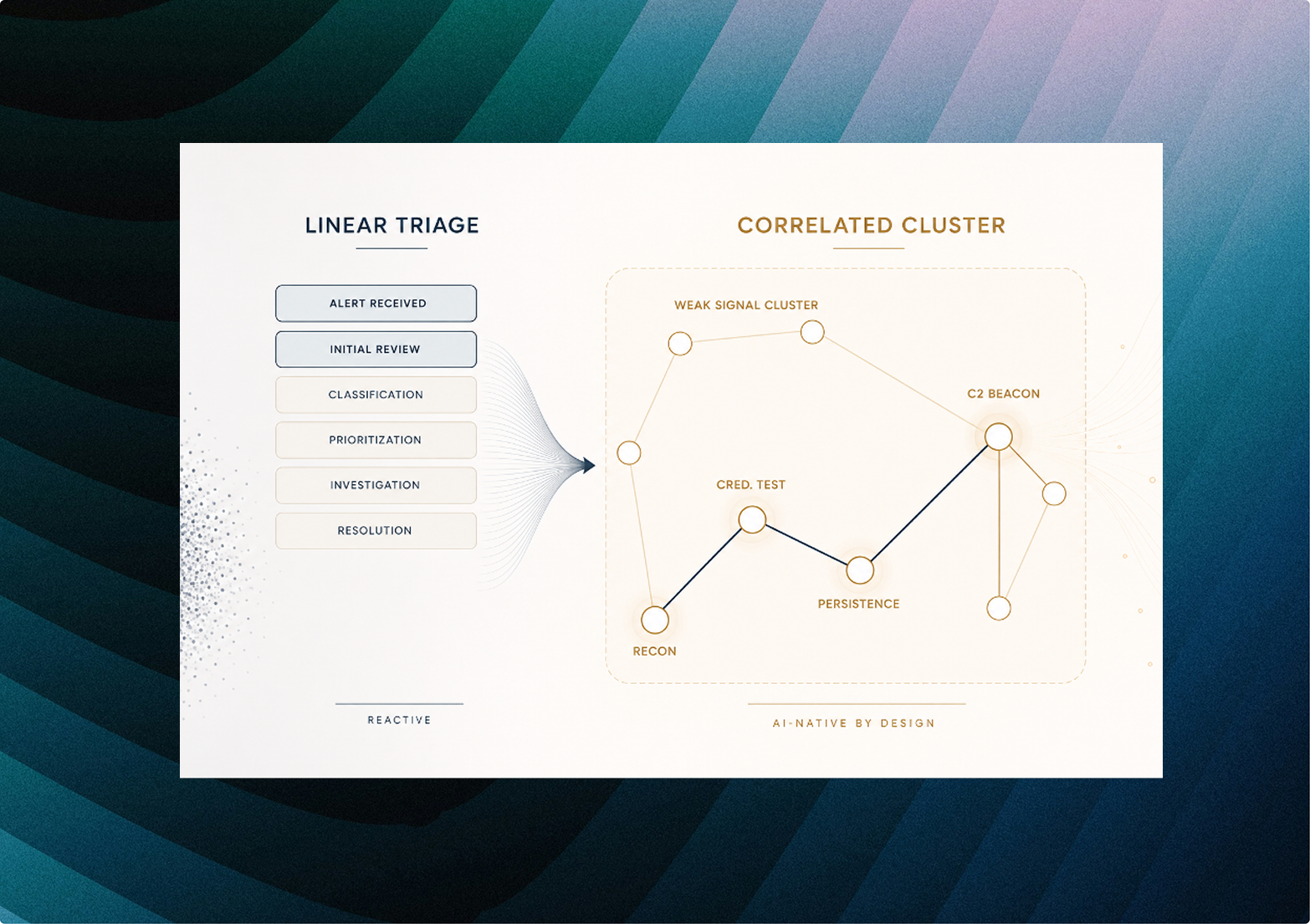
That works when malicious activity leaves a strong signature. It works far less well when an attacker spreads activity across time, identities, and endpoints. A suspicious PowerShell command, a dormant login, a short-lived outbound connection and none of these justify escalation alone. Correlated over weeks, they can describe reconnaissance, credential testing, and command-and-control staging.
How Attackers Exploit the Gap
Attackers know how SOC prioritization works. They know analysts are time-constrained, that detection relies on thresholds, and that isolated anomalies get dismissed when they don't match a known pattern.
Many effective attacks aren't invisible; they're just insufficiently suspicious when viewed one incident at a time. The gap isn't detection coverage; it's the SOC's ability to retain, revisit, and reason across everything it has already seen.
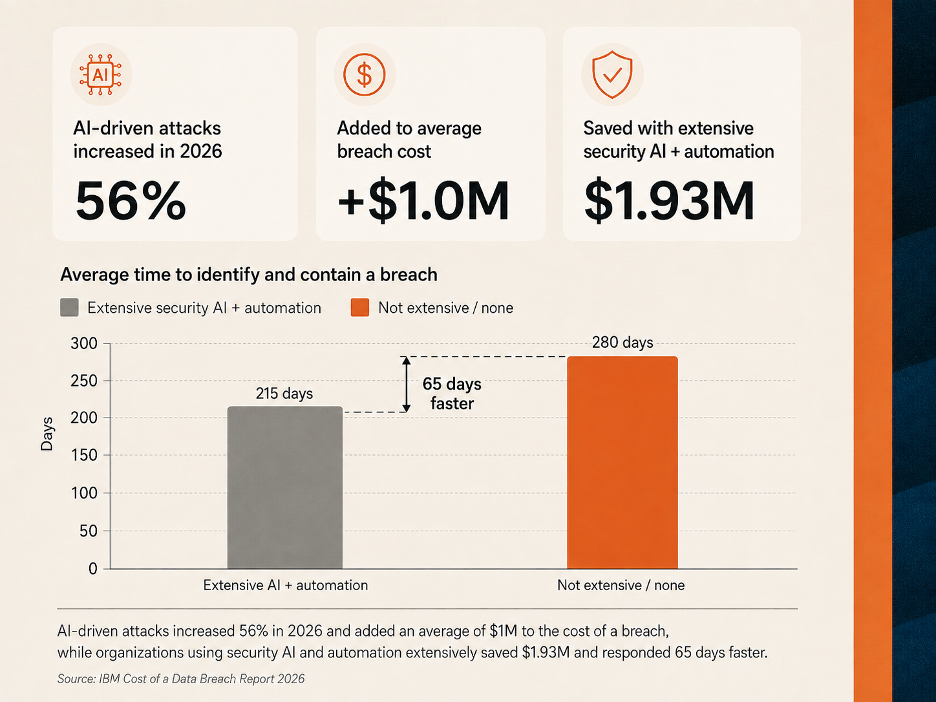
According to IBM's 2026 Cost of a Data Breach Report: security teams that extensively use AI and automation identify and contain breaches 65 days faster and reduce average breach costs by $1.93 million, yet only 36% of breached organizations use these capabilities extensively across prevention, detection, investigation and response.
Why Earlier Correlation Tools Fell Short
Incident correlation isn't new. Earlier platforms linked alerts using statistical similarity, shared entities, timing, and risk scoring as well as clustering activity around users, endpoints, or IPs.
The problem was operational: correlation often produced more alerts and more cases, not fewer. A tool could surface a cluster, but a human still had to decide whether it was a coordinated attack or unrelated noise. Correlation became another queue in an already overloaded SOC, moving the burden downstream instead of reducing it.
What AI Changes
AI changes this in two ways. First, investigation becomes economically scalable because AI can examine process trees, authentication logs, and historical incidents across the environment without an analyst manually opening every case.
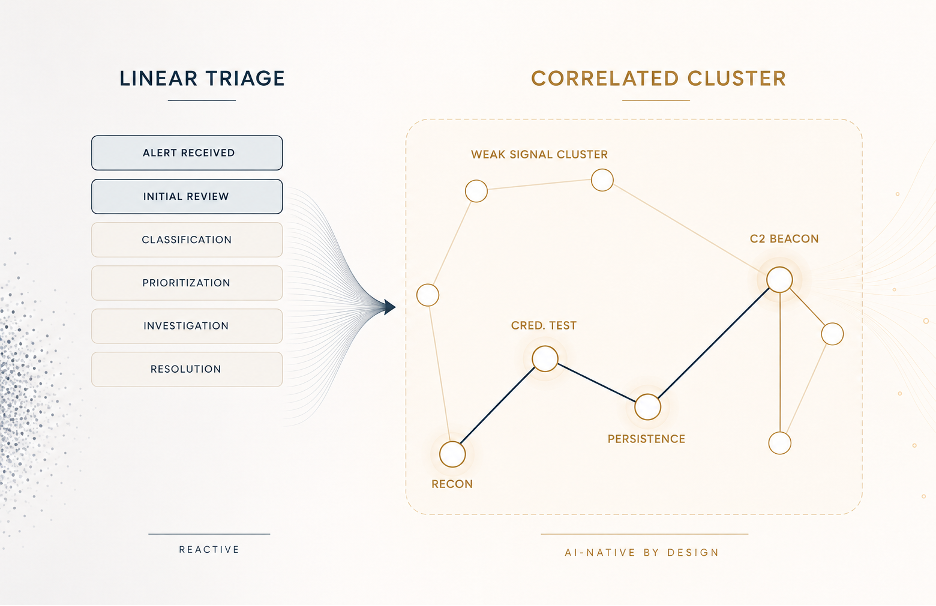
Second, modern language models add a reasoning layer correlation systems never had. Rather than flagging statistical similarity, AI can form and test hypotheses about how incidents relate, weigh conflicting evidence, and explain why a sequence is or isn't consistent with an attack.
Finding Actionable Insights
A low-severity incident no longer has to stay low severity forever. A process tied to an approved update can be re-evaluated if that binary later runs under a different parent process, appears on an unmanaged endpoint, or opens an unexpected connection.
The original call wasn't wrong, however, the surrounding evidence changed. An AI-native SOC can keep asking whether dismissed activity has become meaningful.
Nothing Is Truly Deprioritized
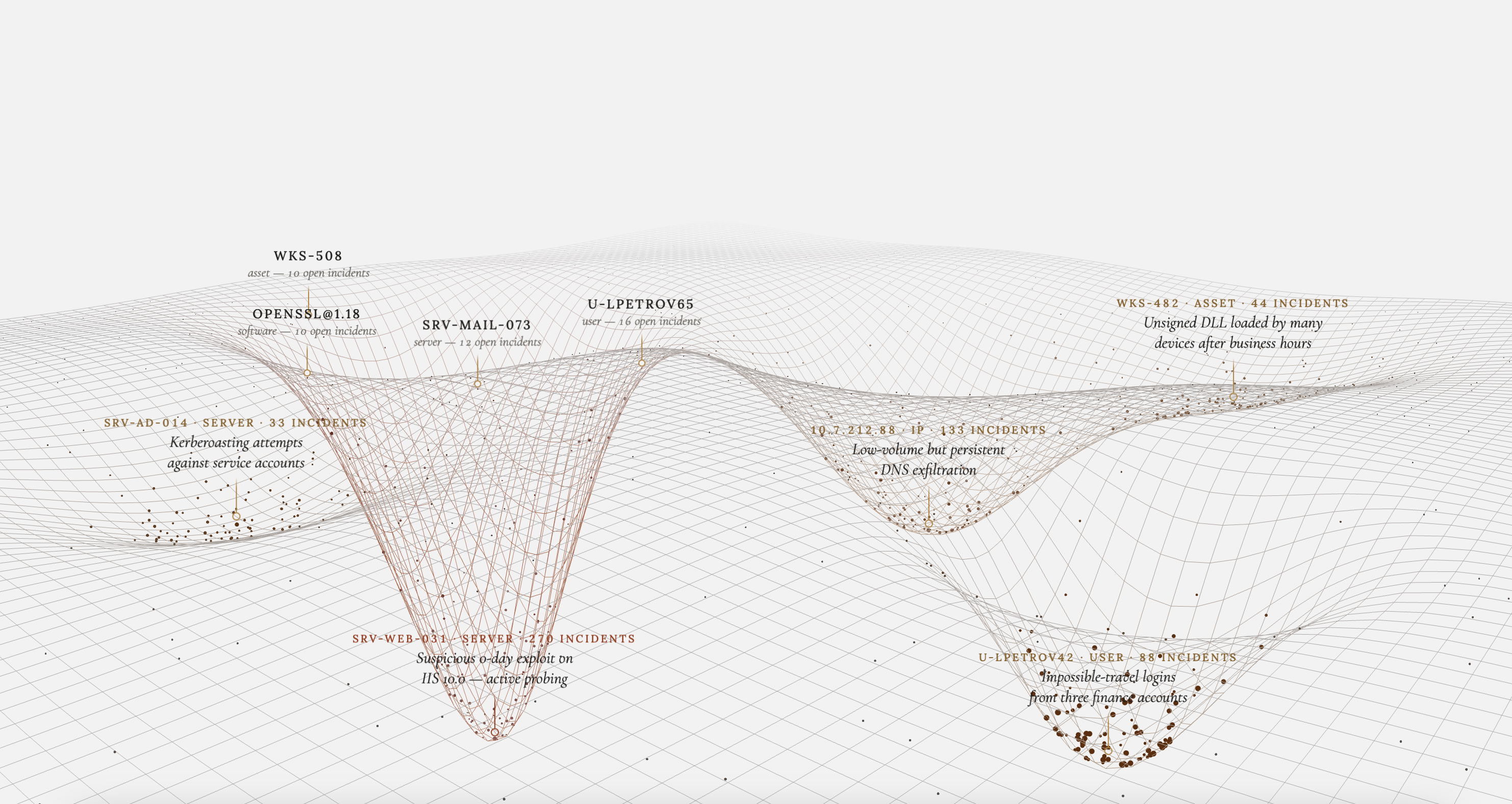
The promise here isn't that every incident gets immediate human attention (that just recreates the scaling problem under a new name). The promise is that nothing is permanently discarded. Every closed case and weak indicator stays available for reassessment against new evidence. For CISOs, that's a different kind of assurance: not a point-in-time judgment made under pressure, but continuous triage running across the full history of the environment. Here is a real-world visualization of how seemingly isolated signals correlate and converge into high-confidence security incidents:
Organizations that get this right won't just automate old run books faster. They'll build processes that let AI investigate broadly, adapt to new evidence, and operate safely within clearly defined limits.
The strongest signal rarely lives inside one incident. It emerges when hundreds of them (including the ones everyone wrote off as garbage) are read together as part of the same evolving story.
Next up: the economics of this shift, and whether an AI-native SOC is actually cheaper to run once investigative work starts moving from analysts to AI.